Curatorial Narrative
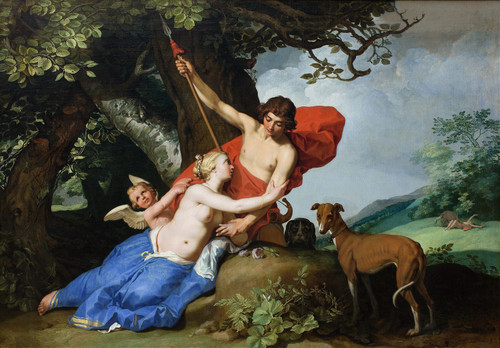
In the context of late 16th-century Flemish art, Abraham Bloemaert's "Mars and Venus" occupies a pivotal position within the burgeoning Baroque style. Executed in 1592, this painting exemplifies the artist's unique blend of Renaissance restraint and emerging dramatic flair. The fine brushwork employed by Bloemaert imbues the scene with an almost tactile quality, as if the very fabric of the painting were being gently manipulated by the viewer's gaze.
The deployment of sepia tones, subtly shaded to convey the soft glow of candlelight or morning sun, creates a luminous atmosphere that envelops both subjects. This chromatic structure is further reinforced by the use of chiaroscuro, which draws the viewer's eye into the heart of the composition while also establishing a clear spatial rhythm. The result is an immersive experience that invites contemplation and reflection.
The subject matter itself, inspired by classical mythology, serves as a testament to Bloemaert's erudition and artistic ambition. By depicting Mars, god of war, surrendering to Venus' charms, the artist subtly subverts traditional iconography, instead emphasizing the transformative power of love. This nuanced approach underscores the painting's inherent depth, inviting multiple readings and interpretations.
Upon enlargement to 44x60, "Mars and Venus" reveals a range of complexities that make it an exemplary addition to any luxury interior environment. The palette, initially subdued in its earthy tones, begins to unfurl into a richer tapestry of textures and hues. Sepia's warmth is now tempered by the introduction of deeper shadows, creating a more pronounced sense of spatial depth.
In this larger format, the painting's atmospheric weight becomes even more pronounced, as if the viewer were standing before an actual scene. The subtle play of light and shadow draws attention to the intricate folds of Mars' armor and the tender curves of Venus' form. This heightened level of detail necessitates a thoughtful consideration of material pairing and lighting behavior within the surrounding space.
The compositional structure, initially harmonious in its balance, begins to exert a greater sense of dynamism upon enlargement. The diagonal movement of Mars' gaze now becomes more apparent, drawing the viewer's eye into a subtle tension with the static form of Venus. This interplay between motion and stasis serves as a powerful reminder of the painting's inherent potential for narrative engagement.
In the context of luxury interior design, "Mars and Venus" presents an opportunity to create a space that is at once intimate and expansive. The painting's spatial rhythm and chromatic structure can be used to guide material choices and lighting decisions, fostering a harmonious dialogue between artwork and environment. By carefully considering the interplay between texture, tone, and luminosity, designers can create a space that is both deeply personal and richly textured.
This edition adapts fluidly across contemporary interior profiles, offering a stable architectural anchor.
Architectural Behavior
Its vertical rise introduces a stabilizing architectural counterpoint.
This edition functions as a 44x60 interior anchor, shaping spatial rhythm and establishing a stable visual cadence within the surrounding architecture.
Its chromatic structure responds to natural and artificial lighting, modulating depth and atmospheric weight throughout the day.
Recommended material pairings include natural oak, brushed metal, matte stone composites, and textured linen surfaces.
Gallery Edition Specifications
- Format: 44" x 60" Interior Architectural Study
- Medium: 330gsm Ultra-Premium Fine Art Matte
- Ink System: Wide-gamut archival pigment curation
- Mounting: Delivered unframed for professional gallery installation
Each edition is prepared to order. Gallery-standard quality control requires 3 to 5 business days.