Curatorial Narrative
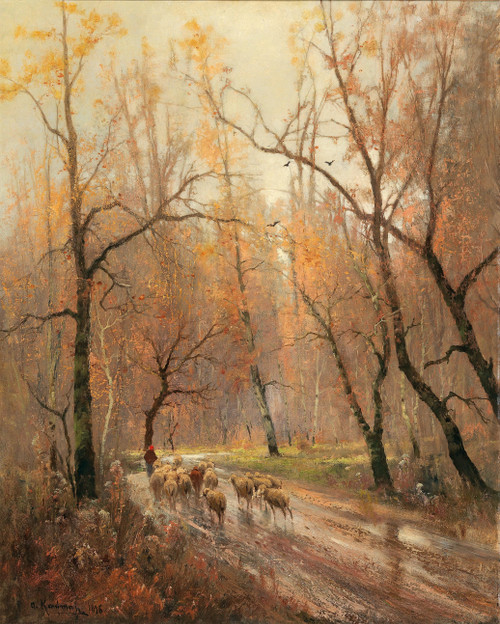
The creation of Adolf Kaufmann's enigmatic "A Shepherdess with a Flock of Sheep" is shrouded in mystery due to the lack of a documented creation date. However, its realist style and impasto technique evoke a sense of late 19th-century Austrian landscape painting, placing it within the broader tradition of rural Romanticism that flourished during this period. Kaufmann's masterful use of impasto creates a textured, almost three-dimensional surface, imbuing the painting with an atmospheric weight that draws the viewer into the scene.
The visual mechanics of Kaufmann's work are characterized by a rich palette that oscillates between cool greens and warm yellows, while his use of browns and blues provides a sense of depth and spatial tension. As we examine the compositional structure, it becomes clear that Kaufmann is employing a traditional design style, one that recalls the rustic simplicity of rural Austria. The spatial rhythm established by the shepherdess's gentle movements and the flock's dispersed presence creates a sense of tranquility, drawing the viewer into the painting's serene atmosphere.
The scale of "A Shepherdess with a Flock of Sheep" at 60x44 inches necessitates a reevaluation of its visual mechanics in relation to luxury interior environments. Upon enlargement, Kaufmann's palette takes on a life of its own, with the greens and blues appearing almost luminescent when paired with richly textured materials such as velvet or linen. The spatial depth established by the impasto technique creates an atmospheric weight that draws attention away from surrounding decor, instead directing it towards the painting itself.
In this larger format, Kaufmann's composition takes on a more imposing presence, its traditional design style and rustic sensibility serving to underscore the luxury interior's own emphasis on heritage and craftsmanship. The spatial rhythm established by the shepherdess and her flock continues to create a sense of tranquility, but one that is now tempered by the awareness of scale and materiality. When paired with judiciously chosen lighting – perhaps warm, golden tones to highlight the painting's textured surface – Kaufmann's work assumes a commanding presence within the luxury interior, its visual mechanics dictating the spatial behavior of surrounding decor.
The impasto technique employed by Kaufmann creates an almost sculptural quality when enlarged, one that draws attention towards the materiality of the painting itself. In this larger format, the chromatic structure established by Kaufmann's palette takes on a more dominant role, with the cool greens and warm yellows creating a sense of visual tension that draws the viewer into the scene.
Upon enlargement, Kaufmann's use of browns and blues provides a sense of depth and spatial complexity, drawing attention towards the painting's compositional structure. The traditional design style employed by Kaufmann continues to recall the rustic simplicity of rural Austria, but now takes on a more imposing presence within the luxury interior environment.
Kaufmann's work is perhaps most effective when paired with materials that echo its own rustic sensibility – natural stone, reclaimed wood, or rough-hewn textiles. The atmospheric weight established by the impasto technique creates a sense of spatial depth that draws attention away from surrounding decor, instead directing it towards the painting itself.
The scale and materiality of Kaufmann's work necessitate a reevaluation of its visual mechanics in relation to luxury interior environments. Upon enlargement, his palette takes on a life of its own, with the greens and blues appearing almost luminescent when paired with richly textured materials such as velvet or linen.
Its grounded tonal structure complements traditional interiors with quiet sophistication.
Architectural Behavior
Its horizontal span reinforces axial movement across long architectural planes.
This edition functions as a 60x44 interior anchor, shaping spatial rhythm and establishing a stable visual cadence within the surrounding architecture.
Its chromatic structure responds to natural and artificial lighting, modulating depth and atmospheric weight throughout the day.
Recommended material pairings include natural oak, brushed metal, matte stone composites, and textured linen surfaces.
Gallery Edition Specifications
- Format: 60" x 44" Interior Architectural Study
- Medium: 330gsm Ultra-Premium Fine Art Matte
- Ink System: Wide-gamut archival pigment curation
- Mounting: Delivered unframed for professional gallery installation
Each edition is prepared to order. Gallery-standard quality control requires 3 to 5 business days.