Curatorial Narrative
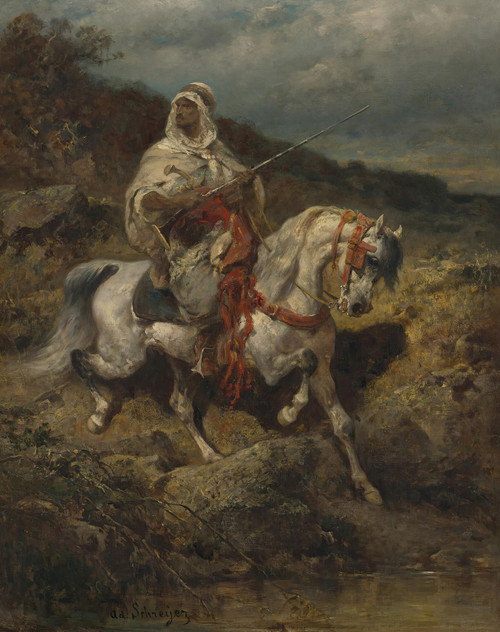
In the context of mid-to-late 19th-century European art, Adolf Schreyer's "Two Reclining Arabs and Two Tethered Horses" occupies a unique position within the Realist movement. Schreyer's masterful employment of impasto brushwork imbues the painting with an almost tactile quality, inviting the viewer to contemplate the rugged, weathered surfaces of the horses and riders. The artist's deliberate choice of muted earthy tones, punctuated by soft yellows and subtle reds, serves to underscore the rustic, traditional subject matter, subtly underscoring the relationship between the natural world and human endeavor.
Upon enlargement, the palette and spatial depth of Schreyer's composition exhibit a marked affinity for classic design. The chromatic structure, comprising rich browns, muted greens, and soft yellows, harmonizes seamlessly with traditional materials such as dark wood paneling or woven textiles. The atmospheric weight of the painting, achieved through Schreyer's deliberate use of impasto to suggest depth and luminosity, is similarly well-suited to environments illuminated by warm, diffused light sources. Spatially, the composition's rhythmic structure – a masterful balance of figures and negative space – proves equally adaptable to large-scale interior arrangements, effortlessly integrating with classic design motifs while also subtly influencing material pairing and spatial flow.
The enlarged scale reveals an even greater sense of atmospheric depth, as if the entire scene is bathed in a soft, diffused light. This quality imbues the artwork with a contemplative, introspective mood that would be perfectly suited to a luxurious interior space, such as a formal study or library. The classic design elements present in Schreyer's composition – the rustic, weathered surfaces of the horses and riders, the traditional subject matter – would integrate harmoniously with materials such as dark wood paneling, woven textiles, and richly patterned rugs.
As the painting is enlarged to 70x44, its chromatic structure takes on a more pronounced role in shaping the spatial atmosphere. The muted greens and browns, for example, blend seamlessly with classic design motifs such as dark wood paneling or intricately carved stone, while the soft yellows and subtle reds add a touch of warmth and visual interest to the overall composition. Spatially, Schreyer's masterful balance of figures and negative space proves equally adaptable to large-scale interior arrangements, effortlessly integrating with traditional design elements such as columns, archways, or sweeping vistas.
The combination of atmospheric depth and classic design motifs creates a sense of spatial cohesion that is perfectly suited to a luxurious interior environment. The painting's chromatic structure, in particular, serves to harmonize the various materials and textures present in the space, creating a sense of visual balance and equilibrium that is both soothing and contemplative. In this way, Schreyer's "Two Reclining Arabs and Two Tethered Horses" assumes its place as a designed object, one whose intricate web of spatial relationships and chromatic structures serves to shape the very atmosphere of the surrounding environment.
The painting's enlarged scale reveals an even greater sense of atmospheric depth, as if the entire scene is bathed in a soft, diffused light. This quality imbues the artwork with a contemplative, introspective mood that would be perfectly suited to a luxurious interior space, such as a formal study or library. The classic design elements present in Schreyer's composition – the rustic, weathered surfaces of the horses and riders, the traditional subject matter – would integrate harmoniously with materials such as dark wood paneling, woven textiles, and richly patterned rugs.
The overall effect of Schreyer's "Two Reclining Arabs and Two
Its grounded tonal structure complements traditional interiors with quiet sophistication.
Architectural Behavior
Its horizontal span reinforces axial movement across long architectural planes.
This edition functions as a 70x44 interior anchor, shaping spatial rhythm and establishing a stable visual cadence within the surrounding architecture.
Its chromatic structure responds to natural and artificial lighting, modulating depth and atmospheric weight throughout the day.
Recommended material pairings include natural oak, brushed metal, matte stone composites, and textured linen surfaces.
Gallery Edition Specifications
- Format: 70" x 44" Interior Architectural Study
- Medium: 330gsm Ultra-Premium Fine Art Matte
- Ink System: Wide-gamut archival pigment curation
- Mounting: Delivered unframed for professional gallery installation
Each edition is prepared to order. Gallery-standard quality control requires 3 to 5 business days.