Curatorial Narrative
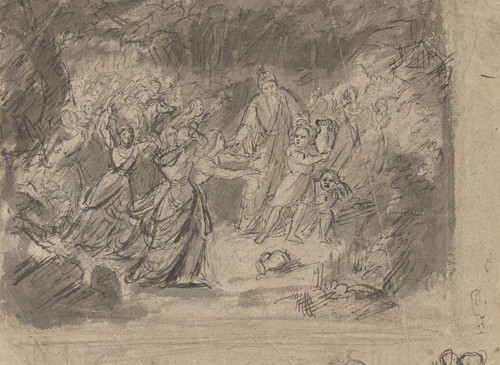
In the midst of the Industrial Revolution, Adolph Tidemand's "Buegang, Altenahr" (1839) occupies a unique position within the Realist movement. The artist's deliberate use of sepia tones and fine brushwork imbues the scene with an almost tactile quality, evoking the very physicality of the landscape itself. By employing a minimalist design style, Tidemand strips away ornamentation to emphasize the underlying structure of the subject matter – in this case, the stark beauty of a rural bridge.
As "Buegang, Altenahr" assumes its full-scale presence on a luxury interior's wall at 60x44 inches, its monochromatic palette takes on a life of its own. The atmospheric weight of the sepia tones deepens, casting a warm glow over adjacent surfaces and imbuing them with a sense of historical gravitas. The chromatic structure of the composition assumes an almost architectural quality, with each brushstroke contributing to a rich spatial rhythm that harmonizes seamlessly with high-end interior design elements – particularly when paired with materials like weathered wood or rough-hewn stone.
Its restrained visual language supports minimalist environments without competing for attention.
Architectural Behavior
Its vertical rise introduces a stabilizing architectural counterpoint.
This edition functions as a 60x44 interior anchor, shaping spatial rhythm and establishing a stable visual cadence within the surrounding architecture.
Its chromatic structure responds to natural and artificial lighting, modulating depth and atmospheric weight throughout the day.
Recommended material pairings include natural oak, brushed metal, matte stone composites, and textured linen surfaces.
Gallery Edition Specifications
- Format: 60" x 44" Interior Architectural Study
- Medium: 330gsm Ultra-Premium Fine Art Matte
- Ink System: Wide-gamut archival pigment curation
- Mounting: Delivered unframed for professional gallery installation
Each edition is prepared to order. Gallery-standard quality control requires 3 to 5 business days.