Curatorial Narrative
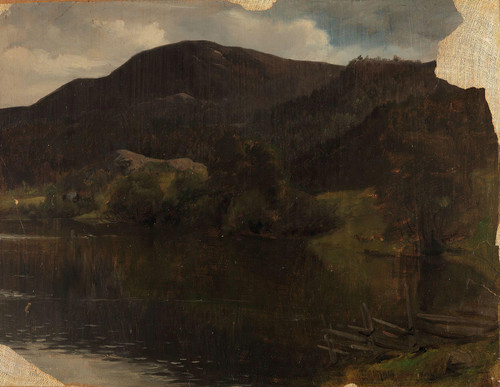
Fanatikerne by Adolph Tidemand is a testament to the artist's commitment to realistic representation, honed through his extensive training in the European art academies. Painted between 1865 and 1866, this genre scene exemplifies the rustic and traditional design styles that dominated Norwegian art of the time, while simultaneously adhering to the Realist movement's emphasis on historical context.
In its monochromatic sepia tones, Fanatikerne exhibits a deliberate restraint, allowing the viewer to focus on the intricate brushwork and atmospheric weight that imbue the scene with an almost palpable sense of tension. This visual strategy is particularly effective when enlarged to 56x44, where the chromatic structure takes on a more pronounced spatial rhythm, guiding the eye through the composition.
When scaled up, the palette's subtle gradations of tone create an intriguing interplay between warm and cool hues, which can be skillfully manipulated in a luxury interior environment. For instance, pairing the painting with richly textured materials such as hand-hewn wood or woven tapestries could further emphasize the atmospheric weight of the scene.
The spatial depth of Fanatikerne is equally noteworthy, as it employs a masterful sense of layering to create an almost three-dimensional quality that can be particularly effective in a large-scale interior installation. This layering effect would benefit from strategic lighting, such as the use of pendant lamps or floor sconces, which could draw attention to specific areas of the composition while casting a warm glow over the surrounding space.
In a luxury interior environment, the spatial impact of Fanatikerne can be used to create an immersive atmosphere that draws the viewer into the world of the painting. By situating the work in a spacious room with high ceilings, the artist's use of atmospheric perspective can be fully appreciated, creating a sense of depth and distance that complements the richness of adjacent materials and finishes.
When displayed in a larger format, the traditional design elements of Fanatikerne take on an added significance, serving as a visual counterpoint to modernist or minimalist interior schemes. This dichotomy highlights the versatility of Tidemand's work, which can be used to create a cohesive visual narrative within even the most disparate of luxury environments.
In its use of spatial rhythm and chromatic structure, Fanatikerne rewards close attention, inviting the viewer to engage with the artwork on multiple levels. By incorporating this painting into a high-end interior design project, architects and designers can tap into the artist's masterful handling of light, texture, and atmosphere, creating an environment that is at once beautiful and thought-provoking.
As an artwork designed for large-scale installation, Fanatikerne demands consideration of its intended setting, where it can be experienced in all its glory. By treating the painting as a designed object rather than simply a print or reproduction, interior designers can create a truly immersive experience that engages the viewer's senses and inspires reflection on the artistic and cultural heritage of Norway.
In a room with high ceilings and ample natural light, Fanatikerne can be used to create an atmosphere of quiet contemplation, as the monochromatic palette and fine brushwork transport the viewer to a bygone era. By pairing this artwork with carefully selected materials and finishes, interior designers can craft a cohesive visual narrative that honors the artistic vision while also responding to the unique demands of its intended setting.
The use of atmospheric perspective in Fanatikerne creates an almost palpable sense of distance, which would be ideally suited to a large-scale installation in a spacious room. By combining this effect with careful material pairing and lighting design, interior designers can create a truly immersive experience that transports viewers into the world of the painting.
Fan
Its grounded tonal structure complements traditional interiors with quiet sophistication.
Architectural Behavior
Its horizontal span reinforces axial movement across long architectural planes.
This edition functions as a 56x44 interior anchor, shaping spatial rhythm and establishing a stable visual cadence within the surrounding architecture.
Its chromatic structure responds to natural and artificial lighting, modulating depth and atmospheric weight throughout the day.
Recommended material pairings include natural oak, brushed metal, matte stone composites, and textured linen surfaces.
Gallery Edition Specifications
- Format: 56" x 44" Interior Architectural Study
- Medium: 330gsm Ultra-Premium Fine Art Matte
- Ink System: Wide-gamut archival pigment curation
- Mounting: Delivered unframed for professional gallery installation
Each edition is prepared to order. Gallery-standard quality control requires 3 to 5 business days.