Curatorial Narrative
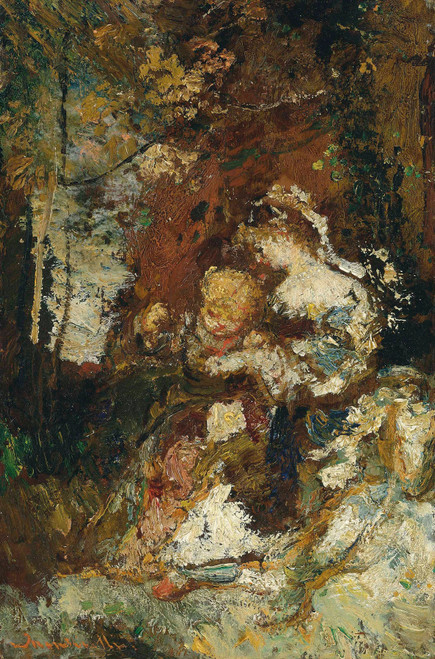
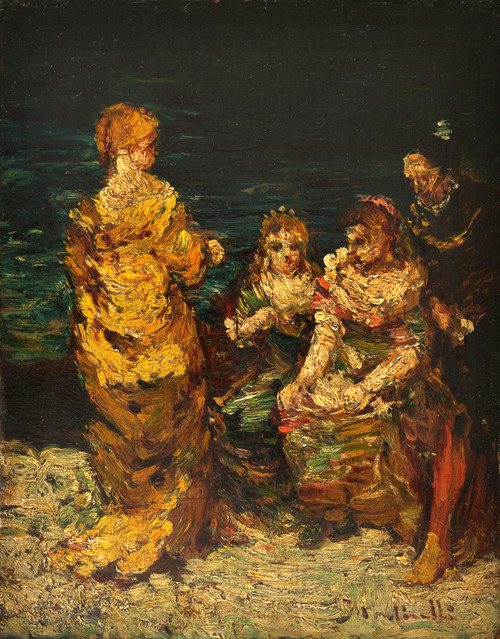
In the mid-nineteenth century, Adolphe Monticelli's "La fillette à la chèvre" stood at the confluence of French Realism and the classical revival. Created in 1851, this painting embodies the tension between the artist's desire to render everyday life with fidelity and his adherence to traditional representational modes. The brushwork is characterized by a fine, almost impasto texture, imbuing the scene with a tactile quality that invites the viewer to engage with its earthy tones of green and brown.
The palette, meanwhile, betrays a Renaissance Revival sensibility in its use of contrasting colors - the pink dress and white goat providing a jarring yet harmonious counterpoint to the somber hues of the landscape. This interplay of light and dark is further accentuated by Monticelli's deployment of chiaroscuro, which imbues the composition with an atmospheric weight that draws the viewer into its spatial rhythm.
When scaled up to 44x60, "La fillette à la chèvre" reveals a profound architectural depth. The earthy tones assume a more substantial presence, their chromatic structure influencing the mood and materiality of the surrounding environment. In a luxury interior context, this would pair well with warm, tactile materials like terracotta or limestone, which would amplify the painting's atmospheric weight.
The composition's classical harmony is also heightened in larger format, its spatial rhythm creating a sense of serenity that belies the tension between light and dark. Lighting behavior becomes critical here, as the contrast between the soft, diffused glow of the surrounding space and the sharp highlights on the goat's fur would create an intriguing dynamic. Spatially, the painting assumes a more commanding presence, its use of negative space becoming almost sculptural in impact. This is particularly relevant when considering how to pair "La fillette à la chèvre" with other design elements - for instance, the clean lines and minimal ornamentation of a well-appointed living room would serve as an elegant counterpoint to the painting's classical structure.
This edition adapts fluidly across contemporary interior profiles, offering a stable architectural anchor.
Architectural Behavior
Its vertical rise introduces a stabilizing architectural counterpoint.
This edition functions as a 44x60 interior anchor, shaping spatial rhythm and establishing a stable visual cadence within the surrounding architecture.
Its chromatic structure responds to natural and artificial lighting, modulating depth and atmospheric weight throughout the day.
Recommended material pairings include natural oak, brushed metal, matte stone composites, and textured linen surfaces.
Gallery Edition Specifications
- Format: 44" x 60" Interior Architectural Study
- Medium: 330gsm Ultra-Premium Fine Art Matte
- Ink System: Wide-gamut archival pigment curation
- Mounting: Delivered unframed for professional gallery installation
Each edition is prepared to order. Gallery-standard quality control requires 3 to 5 business days.