Curatorial Narrative
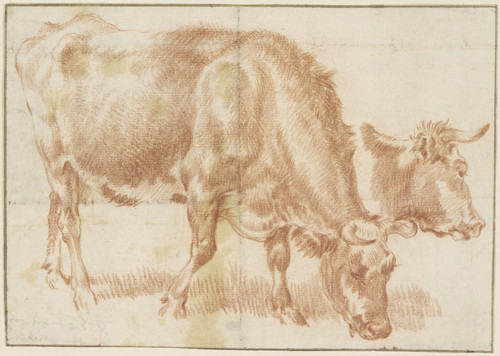
In "Liegendes Rind nach rechts," Adriaen van de Velde presents a masterful exemplar of classical technique, one that simultaneously nods to the era's emphasis on naturalism and its tendency towards idealized representation. The work's creation is likely dated to the late 17th century, when the artist was at the height of his powers.
The painter's brushwork is characterized by softness, a subtle manipulation of pigment that imbues the composition with an almost ethereal quality. Warm earth tones and sepia hues pervade the palette, imbuing the space with an atmospheric weight that feels both grounded and expansive. The minimalist design style allows for a spare, modernist structure to emerge, one in which the compositional elements seem to unfold within a carefully calibrated spatial rhythm.
When enlarged to 53x44 inches, the work's chromatic structure becomes even more pronounced, its warm tones seeming to expand outward like a slowly unfurling scroll. In this larger format, the painting's palette assumes an almost three-dimensional quality, its deep sepia hues and golden undertones imbuing the surrounding space with a rich, material presence that draws the viewer's eye inexorably toward the canvas.
Within a luxury interior environment, "Liegendes Rind nach rechts" would assume a commanding presence, its warm palette and atmospheric depth seeming to merge seamlessly with surrounding materials like dark wood paneling or polished marble. The painting's minimalist design style would allow it to function as a kind of anchor or pivot point within the space, its subtle coloration and nuanced spatial rhythm imbuing the surrounding environment with an understated sense of drama and visual tension.
In terms of material pairing, the work's earthy tones and sepia hues would be ideally complemented by richly textured surfaces like velvet or linen, while the painting's minimalist design style would allow it to pair equally effectively with modernist or contemporary architectural elements. The overall effect would be one of serene balance and visual equilibrium, as if the painting had been carefully calibrated to harmonize with its surroundings rather than dominate them.
The lighting behavior within a space featuring "Liegendes Rind nach rechts" would likely be characterized by soft, diffused illumination that seems to emerge organically from the surrounding environment itself. This subtle, ambient light would allow the painting's warm palette and atmospheric depth to assume an almost palpable presence, imbuing the surrounding space with a sense of relaxed, visual repose.
Ultimately, "Liegendes Rind nach rechts" assumes its most compelling form when viewed as a designed object, one that has been carefully calibrated to interact with its surroundings in a way that is both visually intuitive and spatially harmonious.
This edition's spatial clarity and controlled palette align naturally with modernist interiors.
Architectural Behavior
Its horizontal span reinforces axial movement across long architectural planes.
This edition functions as a 53x44 interior anchor, shaping spatial rhythm and establishing a stable visual cadence within the surrounding architecture.
Its chromatic structure responds to natural and artificial lighting, modulating depth and atmospheric weight throughout the day.
Recommended material pairings include natural oak, brushed metal, matte stone composites, and textured linen surfaces.
Gallery Edition Specifications
- Format: 53" x 44" Interior Architectural Study
- Medium: 330gsm Ultra-Premium Fine Art Matte
- Ink System: Wide-gamut archival pigment curation
- Mounting: Delivered unframed for professional gallery installation
Each edition is prepared to order. Gallery-standard quality control requires 3 to 5 business days.