Curatorial Narrative
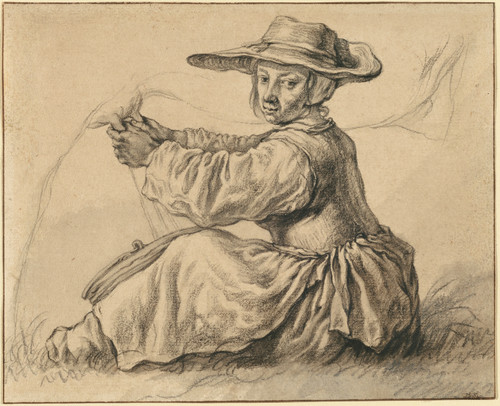
In the realm of 17th-century Dutch painting, Aelbert Cuyp's "A Milkmaid" occupies a privileged position within the Baroque tradition. Executed between 1642 and 1646, this work exemplifies Cuyp's characteristic softness, which is achieved through a masterful manipulation of brushwork that imbues the image with an air of subtlety. The artist's deliberate use of neutral tones and soft shading creates a dreamlike atmosphere, one that invites the viewer to surrender to the quiet intimacy of the milkmaid's daily routine.
When enlarged to approximately 54x44 inches, "A Milkmaid" assumes a commanding presence, its spatial depth and compositional structure yielding a powerful sense of atmospheric weight. The neutral palette, while initially understated, unfolds into a rich tapestry of chromatic nuances that seem to shimmer with an almost otherworldly light. In a luxury interior environment, this painting's material pairing would be carefully considered, perhaps with wood or stone surfaces chosen to complement the earthy tones and textures evoked by Cuyp's brushwork.
As the eye navigates the spatial rhythm of "A Milkmaid", it is drawn inexorably towards the subject, whose tranquil presence seems to anchor the surrounding space. The subtle interplay between light and shadow creates a sense of depth, while the artist's deliberate use of soft focus imbues the image with a quality of languid ease. In such an environment, this painting would function as a masterful exercise in restraint, its understated beauty a counterpoint to the opulence of surrounding materials and furnishings.
In a setting designed with Cuyp's "A Milkmaid" in mind, one might imagine a room whose surfaces are carefully calibrated to reflect the quiet luminosity of the painting. The wood or stone walls would provide a subtle backdrop for the artist's masterful deployment of light and shadow, while the surrounding furniture – perhaps crafted from richly textured woods or upholstered in sumptuous fabrics – would be chosen to echo the tactile nuances of Cuyp's brushwork.
The spatial impact of "A Milkmaid" is equally significant, its presence subtly altering the viewer's experience of the surrounding space. As one moves through the room, the painting seems to unfold like a gentle mist, its soft edges and subtle nuances shifting with each step. This is an artwork that rewards close attention, its beauty unfolding slowly and inexorably as the viewer becomes increasingly immersed in Cuyp's dreamlike world.
In a luxury interior environment, Cuyp's "A Milkmaid" would function as a masterful exercise in restraint, its understated beauty a counterpoint to the opulence of surrounding materials and furnishings. Its spatial depth and compositional structure yield a powerful sense of atmospheric weight, while the neutral palette unfolds into a rich tapestry of chromatic nuances that seem to shimmer with an almost otherworldly light.
As one considers Cuyp's "A Milkmaid" in its enlarged form, it becomes clear that this painting is not simply a work of art, but a designed object whose every aspect has been carefully calibrated to create a specific experience. Its material pairing, lighting behavior, and spatial impact all conspire to transport the viewer into a realm of quiet intimacy, one that is both deeply personal and profoundly evocative.
In the context of Baroque interior design, Cuyp's "A Milkmaid" assumes a position of rare elegance, its softness and subtlety providing a subtle counterpoint to the more dramatic flourishes of the period. This is an artwork that rewards close attention, its beauty unfolding slowly and inexorably as the viewer becomes increasingly immersed in Cuyp's dreamlike world.
As one contemplates the relationship
This edition adapts fluidly across contemporary interior profiles, offering a stable architectural anchor.
Architectural Behavior
Its vertical rise introduces a stabilizing architectural counterpoint.
This edition functions as a 54x44 interior anchor, shaping spatial rhythm and establishing a stable visual cadence within the surrounding architecture.
Its chromatic structure responds to natural and artificial lighting, modulating depth and atmospheric weight throughout the day.
Recommended material pairings include natural oak, brushed metal, matte stone composites, and textured linen surfaces.
Gallery Edition Specifications
- Format: 54" x 44" Interior Architectural Study
- Medium: 330gsm Ultra-Premium Fine Art Matte
- Ink System: Wide-gamut archival pigment curation
- Mounting: Delivered unframed for professional gallery installation
Each edition is prepared to order. Gallery-standard quality control requires 3 to 5 business days.