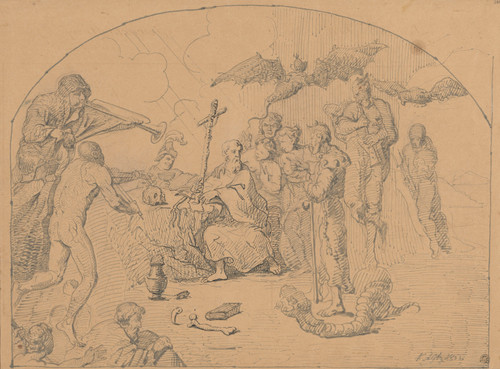
Curatorial Narrative
In the early 16th century, Netherlandish Renaissance masters began to explore the intersections of sacred and profane through still life compositions. After Hieronymus Bosch's "The Temptation of St Anthony" embodies this trend, as a highly charged, symbolic painting that subverts expectations of traditional devotional art. The artist's technique is characterized by fine brushwork that imbues the dark earth tones, muted reds and blues, and subtle greens with an almost tactile quality, inviting the viewer to engage with the painted surface on a visceral level. As such, the work can be seen as an exercise in chromatic structure, where each element - from the crawling insects to the saint's rapt expression - contributes to a dense, atmospheric weight that pervades the composition.
As one considers "The Temptation of St Anthony" enlarged to 56x44 inches, several key aspects of its visual mechanics come into play. The palette, originally suited to the intimate scale of an altarpiece or devotional panel, expands to fill a luxurious interior space with its rich, almost somber tones. This larger format also accentuates the spatial rhythm established by the artist's use of layered planes and subtle shifts in scale, creating a sense of visual tension that is both captivating and unsettling. In this environment, the material pairing possibilities are vast: a deep, dark wood such as ebony or walnut would provide an apt contrast to the painting's muted palette, while strategically placed lighting sources could draw out specific elements within the composition, such as the saint's ecstatic gaze or the sinuous curves of the serpent. The overall effect would be one of deliberate, measured drama, as if the very space itself were a carefully crafted still life, poised between serenity and turmoil.
This edition's spatial clarity and controlled palette align naturally with modernist interiors.
Architectural Behavior
Its horizontal span reinforces axial movement across long architectural planes.
This edition functions as a 56x44 interior anchor, shaping spatial rhythm and establishing a stable visual cadence within the surrounding architecture.
Its chromatic structure responds to natural and artificial lighting, modulating depth and atmospheric weight throughout the day.
Recommended material pairings include natural oak, brushed metal, matte stone composites, and textured linen surfaces.
Gallery Edition Specifications
- Format: 56" x 44" Interior Architectural Study
- Medium: 330gsm Ultra-Premium Fine Art Matte
- Ink System: Wide-gamut archival pigment curation
- Mounting: Delivered unframed for professional gallery installation
Each edition is prepared to order. Gallery-standard quality control requires 3 to 5 business days.