Curatorial Narrative
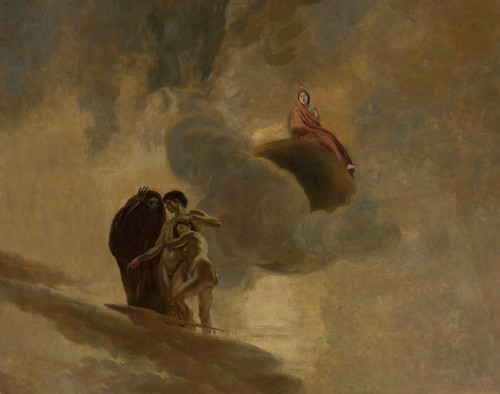
In the realm of late 19th-century French art, Albert Besnard's Etude d'homme pour l'école de pharmacie stands as a nuanced exemplar of the era's emerging interest in modernity and the human form. Painted in 1883, this work showcases Besnard's technical prowess with hard brushwork that imbues his subjects with an air of quiet introspection. The neutral palette of beige and gray - a hallmark of minimalist design styles then beginning to emerge - serves as a deliberate counterpoint to the emerging Impressionist movement's emphasis on color and light.
As the work is scaled up to 55x44, its chromatic structure assumes a more pronounced role in shaping the surrounding space. The interplay between light and material becomes particularly noteworthy: the subtle gradations of gray evoke an almost tactile sense of atmospheric weight, which can be effectively counterbalanced by judicious placement of richer materials such as dark wood or sumptuous textiles. When paired with carefully calibrated lighting - perhaps a minimalist fixture that highlights the subject's contemplative demeanor - Besnard's Etude d'homme pour l'école de pharmacie assumes a commanding presence within a luxury interior, its spatial rhythm and structural integrity imbuing the surrounding space with a sense of refined discipline.
The work's deliberate use of negative space fosters an almost palpable sense of restraint, which can be elegantly exploited by designers seeking to create sophisticated, modernist enclaves. By pairing Besnard's Etude d'homme pour l'école de pharmacie with suitably understated architectural elements - such as a minimalist console table or sleek floor lamp - the surrounding space is transformed into a nuanced dialogue between art and architecture.
By virtue of its carefully calibrated design structure, Besnard's work assumes an almost symbiotic relationship with the surrounding environment, its spatial depth and compositional rhythms assuming a life of their own as they interact with the viewer. This synergy can be expertly leveraged by designers seeking to create spaces that are at once refined, sophisticated, and deeply human.
The work's focus on the figure - in this case, a studious young man lost in contemplation - imbues the surrounding space with a sense of quiet introspection, its spatial rhythm and atmospheric weight perfectly calibrated to evoke a sense of stillness. When paired with judicious placement of carefully selected materials and lighting, Besnard's Etude d'homme pour l'école de pharmacie assumes a commanding presence within a luxury interior, its subtle nuances and refined sensibilities elevating the surrounding space into a veritable temple of quiet contemplation.
The work's minimalist style - replete with neutral tones and carefully calibrated design elements - lends itself perfectly to pairing with an array of sumptuous materials and textures. Dark wood paneling or richly patterned textiles can be expertly used to create a sense of contrast, while judicious placement of lighting fixtures can help draw the viewer's eye towards Besnard's masterful rendering of his subject.
In its carefully calibrated design structure, Besnard's Etude d'homme pour l'école de pharmacie assumes an almost symbiotic relationship with the surrounding environment. By virtue of its spatial depth and compositional rhythms, the work transcends its two-dimensional existence to become a fully realized presence within the space. This synergy can be expertly leveraged by designers seeking to create spaces that are at once refined, sophisticated, and deeply human.
By pairing Besnard's Etude d'homme pour l'école de pharmacie with suitably understated architectural elements - such as a minimalist console table or sleek floor lamp - the surrounding space is transformed into a nuanced dialogue between art and architecture. The work's focus on the figure -
This edition's spatial clarity and controlled palette align naturally with modernist interiors.
Architectural Behavior
Its horizontal span reinforces axial movement across long architectural planes.
This edition functions as a 55x44 interior anchor, shaping spatial rhythm and establishing a stable visual cadence within the surrounding architecture.
Its chromatic structure responds to natural and artificial lighting, modulating depth and atmospheric weight throughout the day.
Recommended material pairings include natural oak, brushed metal, matte stone composites, and textured linen surfaces.
Gallery Edition Specifications
- Format: 55" x 44" Interior Architectural Study
- Medium: 330gsm Ultra-Premium Fine Art Matte
- Ink System: Wide-gamut archival pigment curation
- Mounting: Delivered unframed for professional gallery installation
Each edition is prepared to order. Gallery-standard quality control requires 3 to 5 business days.