Curatorial Narrative
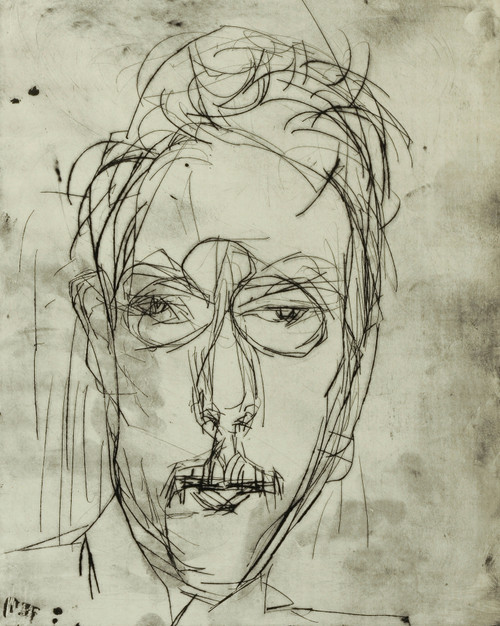
In 1925, Albert Müller's "Portrait Ernst Ludwig Kirchner II" emerges as a prime example of Abstract Expressionism, its creation coinciding with the avant-garde movements sweeping through Germany at the time. The artist's technique is characterized by linear brushwork, a deliberate choice that imbues the composition with an air of spontaneity while maintaining a sense of control. The palette is dominated by a vibrant orange hue, tempered by black accents that function as both visual anchors and tonal modulators.
As the painting's dimensions expand to 44x46, its spatial depth and compositional structure begin to exert a profound influence on the surrounding environment. The chromatic structure, predicated upon the unyielding presence of orange, assumes a life of its own, imbuing the space with an almost palpable weight that is both soothing and energizing. When paired with luxurious materials such as velvet or silk, the painting's atmospheric weight finds a worthy counterpoint in the tactile qualities of these textures. Lighting behavior becomes particularly noteworthy, as the painting appears to shift and change color in response to subtle variations in illumination. In this manner, "Portrait Ernst Ludwig Kirchner II" assumes its rightful place within the luxury interior, its Minimalist design style providing a crisp foil for the surrounding opulence while subtly asserting its own status as a masterwork of Modern art.
The spatial rhythm established by Müller's composition is one of measured tension and release, with each element carefully calibrated to produce a sense of dynamic equilibrium. This quality finds an unexpected harmony when juxtaposed with sleek, low-profile furniture that eschews ornamentation in favor of clean lines and minimalist silhouettes. As the painting asserts its presence within this carefully curated environment, it subtly reconfigures our understanding of spatial relationships, inviting us to contemplate anew the interplay between art, architecture, and interior design.
In terms of material pairing, the painting's palette presents a compelling case for a supporting cast of rich, earthy tones that complement its fiery orange without overpowering it. The black accents, meanwhile, suggest a judicious use of metallic or glass surfaces to provide a sense of depth and visual contrast. Throughout, the goal is to create an atmosphere of refined tension, one in which each element coexists in harmony with the others while contributing its unique properties to the overall effect.
The atmospheric weight exerted by "Portrait Ernst Ludwig Kirchner II" assumes a particularly interesting dynamic when enlarged to 44x46. In this format, its chromatic structure appears to expand outward from the canvas, gradually engulfing the surrounding space in a rich, immersive glow that is both captivating and deeply unsettling.
This edition's spatial clarity and controlled palette align naturally with modernist interiors.
Architectural Behavior
Its vertical rise introduces a stabilizing architectural counterpoint.
This edition functions as a 44x46 interior anchor, shaping spatial rhythm and establishing a stable visual cadence within the surrounding architecture.
Its chromatic structure responds to natural and artificial lighting, modulating depth and atmospheric weight throughout the day.
Recommended material pairings include natural oak, brushed metal, matte stone composites, and textured linen surfaces.
Gallery Edition Specifications
- Format: 44" x 46" Interior Architectural Study
- Medium: 330gsm Ultra-Premium Fine Art Matte
- Ink System: Wide-gamut archival pigment curation
- Mounting: Delivered unframed for professional gallery installation
Each edition is prepared to order. Gallery-standard quality control requires 3 to 5 business days.