Curatorial Narrative
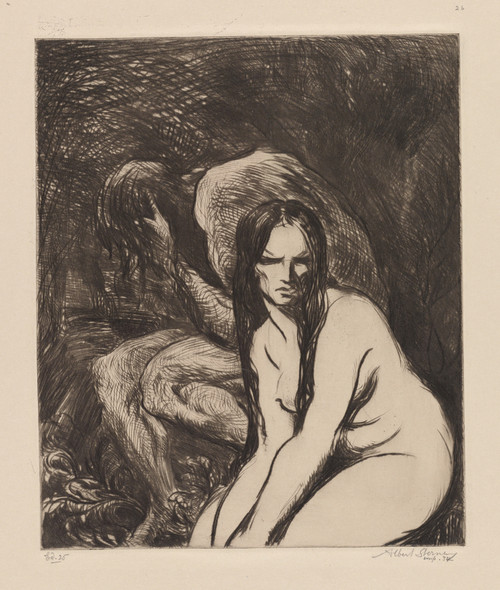
In the early 1930s, Albert Sterner's oeuvre was characterized by a growing preoccupation with capturing the essence of modern life through Expressionist means. His work during this period exemplifies a deliberate departure from the representational conventions of earlier art movements, instead embracing the fluid, dynamic energy of urban experience. "Meditation" (1933) represents a pivotal moment in Sterner's development as an artist, as he distilled his figurative style to reveal a meditative introspection.
As the palette is reduced to black and white, Sterner achieves a crispness that underscores the linear quality of his brushwork. This dichromatic structure imbues the composition with an atmospheric weight that seems almost sculptural in its three-dimensionality. When "Meditation" is enlarged to 56x44, the spatial rhythm becomes more pronounced, drawing the viewer's eye across a carefully calibrated balance of positive and negative space. The Art Deco influence is evident in the geometric abstraction of the subject's form, while the Modernist underpinnings are revealed in the artist's use of clean lines and an absence of ornamentation.
As "Meditation" occupies a luxury interior environment, its black and white chromatic structure serves to amplify the materiality of adjacent surfaces. The linear brushwork creates a visual tension that is effectively counterbalanced by the rich textures and sumptuous materials often found in high-end design. When paired with a judicious selection of lighting fixtures – perhaps a combination of table lamps and floor lamps – the atmospheric weight of "Meditation" can be subtly manipulated to create areas of heightened focus or quiet contemplation within the space.
The Modernist inclinations of Sterner's work also extend to its engagement with the viewer on an experiential level. As "Meditation" fills a given spatial context, it influences the way in which one navigates the surrounding area – subtly recalibrating the visual axis and creating new pathways for the eye to follow. In this manner, the print assumes a designed object quality that is both aesthetically compelling and functionally integral to the space itself.
The Art Deco motifs present within "Meditation" also lend themselves to consideration in terms of material pairing – particularly when paired with metallic surfaces or dark wood tones. The interplay between these materials can create an interesting visual dialectic, as the geometric abstraction of the subject's form is subtly echoed by the angular lines and planes of adjacent elements. This dynamic serves to underscore the print's role as a designed object within the space, blurring the boundaries between art and interior decoration.
When positioned in a luxury interior environment, "Meditation" occupies a unique position at the nexus of artistic expression and spatial experience. Its carefully calibrated balance of positive and negative space creates an atmosphere that is both contemplative and dynamic – one that invites the viewer to engage with its modernist essence while also acknowledging the historical context from which it emerged.
The black and white palette of "Meditation" serves as a deliberate counterpoint to the rich colors and textures often found in high-end interior design, creating an intriguing visual dialectic that underscores the print's role as a designed object. As this dichromatic structure interacts with adjacent materials – perhaps a combination of dark wood tones and metallic surfaces – it assumes a spatial quality that is both sculptural and atmospheric.
The linear brushwork present within "Meditation" imbues the composition with a dynamic energy that seems almost kinetic in its effect. This fluidity is effectively balanced by the geometric abstraction of the subject's form, which creates an intriguing visual tension that is well-suited to the Art Deco influences often found in luxury interior design.
In the hands of
This edition's spatial clarity and controlled palette align naturally with modernist interiors.
Architectural Behavior
Its horizontal span reinforces axial movement across long architectural planes.
This edition functions as a 56x44 interior anchor, shaping spatial rhythm and establishing a stable visual cadence within the surrounding architecture.
Its chromatic structure responds to natural and artificial lighting, modulating depth and atmospheric weight throughout the day.
Recommended material pairings include natural oak, brushed metal, matte stone composites, and textured linen surfaces.
Gallery Edition Specifications
- Format: 56" x 44" Interior Architectural Study
- Medium: 330gsm Ultra-Premium Fine Art Matte
- Ink System: Wide-gamut archival pigment curation
- Mounting: Delivered unframed for professional gallery installation
Each edition is prepared to order. Gallery-standard quality control requires 3 to 5 business days.