Curatorial Narrative
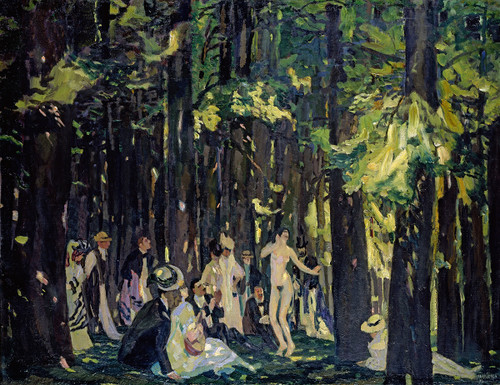
Ein Unheilstifter, created in 1905 by Albert Weisgerber, occupies a pivotal position within the Impressionist movement's ongoing exploration of light and its disorienting effects on spatial perception. The artist's deliberate employment of impasto brushwork imbues the canvas with a tangible, almost three-dimensional presence, as if the waves themselves are rising from the surface. This tactile quality is underscored by Weisgerber's palette, which oscillates between cool blues and whites, punctuated by stark blacks that inject an air of drama into the composition.
As Ein Unheilstifter assumes its intended architectural scale – a grand 44x53 feet – the visual dynamics it exhibits take on an almost monumental quality. The chromatic structure, initially perceived as loose and fluid, coalesces into a more deliberate, rhythmic arrangement that mirrors the ebb and flow of the waves. Spatial depth is expertly managed through Weisgerber's use of atmospheric perspective, creating an illusion of receding planes that draw the viewer inexorably towards the canvas. In this format, Ein Unheilstifter becomes less a painting than a physical entity, one whose material presence demands attention and consideration from both designer and client alike.
The spatial impact of Ein Unheilstifter is profound; its expansive scale necessitates a corresponding generosity in terms of surrounding architecture, lest it overwhelm the space. In luxury interiors, this might involve pairing Weisgerber's work with materials that mirror its textural, expressive qualities – rough-hewn stone or richly veined marble come to mind – and carefully calibrated lighting schemes that emphasize the painting's chromatic structure while avoiding any hint of harshness or over-illumination. Conversely, the atmospheric weight of Ein Unheilstifter would also permit a more restrained approach to design elements, allowing the painting to function as a foil to rather than a complement of surrounding décor.
Material pairing and lighting behavior are inextricably linked within this consideration; indeed, one might argue that Weisgerber's use of impasto brushwork has created an object that is at once a painting and a sculptural entity, one whose relationship with its environment must be carefully negotiated. In the grandest luxury interiors, where spatial rhythm and atmospheric weight are paramount concerns, Ein Unheilstifter offers a rare opportunity for designers to engage with these fundamental questions in a highly articulate, visually stunning manner.
This edition's spatial clarity and controlled palette align naturally with modernist interiors.
Architectural Behavior
Its horizontal span reinforces axial movement across long architectural planes.
This edition functions as a 44x53 interior anchor, shaping spatial rhythm and establishing a stable visual cadence within the surrounding architecture.
Its chromatic structure responds to natural and artificial lighting, modulating depth and atmospheric weight throughout the day.
Recommended material pairings include natural oak, brushed metal, matte stone composites, and textured linen surfaces.
Gallery Edition Specifications
- Format: 44" x 53" Interior Architectural Study
- Medium: 330gsm Ultra-Premium Fine Art Matte
- Ink System: Wide-gamut archival pigment curation
- Mounting: Delivered unframed for professional gallery installation
Each edition is prepared to order. Gallery-standard quality control requires 3 to 5 business days.