Curatorial Narrative
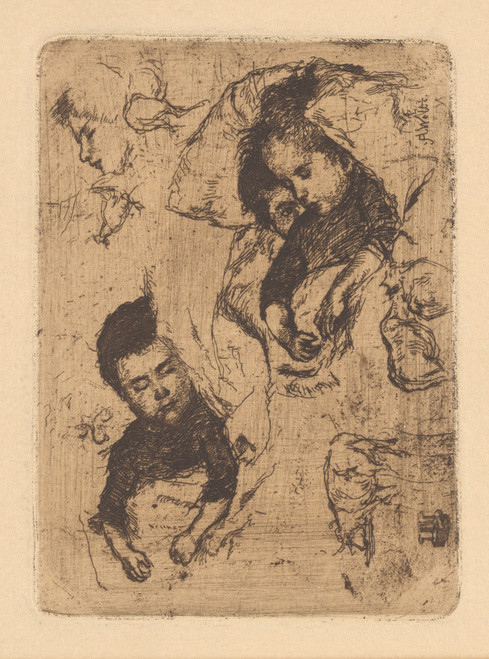
"Kinder und Eltern", created by Albert Welti in 1901, stands at the intersection of Expressionist fervor and Modernist ambitions. The artist's linear brushwork imbues the figurative scene with an almost diagrammatic quality, as if striving to capture the essence of its subjects through a rationalized representation. The monochromatic palette, characteristic of early 20th-century avant-garde movements, lends a stark, atmospheric weight to the composition.
As "Kinder und Eltern" is enlarged to 44x63 inches, its chromatic structure assumes a commanding presence within a luxury interior environment. The black and white tones engage in a subtle dance with surrounding materials, generating an interplay of contrasts that heighten spatial rhythm and visual tension. The starkness of the composition's atmosphere, in turn, influences lighting behavior by accentuating the ambient conditions of its surroundings: warm glow from adjacent fixtures or soft illumination through sheer curtains can imbue the scene with a hushed intimacy, while bold lighting treatments amplify its emotional resonance.
The linear brushstrokes and graphic arrangement of "Kinder und Eltern" facilitate an interplay between material and light that is characteristic of early 20th-century Modernism. In this context, Welti's work exemplifies the tensions between representation and abstraction, formality and expressiveness, that define Expressionist aesthetics.
The spatial depth and compositional structure of "Kinder und Eltern" are such that they assume a dynamic relationship with adjacent architectural features, as if constantly recalibrating its interaction with the viewer. As an individual work within a larger interior environment, it assumes the role of a distinct object, demanding consideration for both its physical placement and visual dialogue with other components of the space.
Within a luxury interior, "Kinder und Eltern" exerts a strong influence on material pairing by subtly directing attention towards specific textures and finishes. Its graphic arrangement heightens awareness of adjacent architectural features, such as moldings or paneling, while the contrast between its monochromatic palette and adjacent colors draws attention to surrounding materials.
The work's overall presence within an interior space is one of measured restraint, reflecting the rationalized aesthetic of early 20th-century Modernism.
This edition's spatial clarity and controlled palette align naturally with modernist interiors.
Architectural Behavior
Its vertical rise introduces a stabilizing architectural counterpoint.
This edition functions as a 44x63 interior anchor, shaping spatial rhythm and establishing a stable visual cadence within the surrounding architecture.
Its chromatic structure responds to natural and artificial lighting, modulating depth and atmospheric weight throughout the day.
Recommended material pairings include natural oak, brushed metal, matte stone composites, and textured linen surfaces.
Gallery Edition Specifications
- Format: 44" x 63" Interior Architectural Study
- Medium: 330gsm Ultra-Premium Fine Art Matte
- Ink System: Wide-gamut archival pigment curation
- Mounting: Delivered unframed for professional gallery installation
Each edition is prepared to order. Gallery-standard quality control requires 3 to 5 business days.