Curatorial Narrative
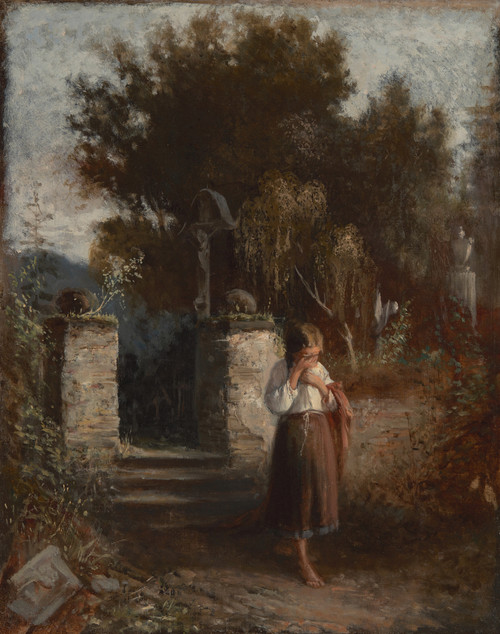
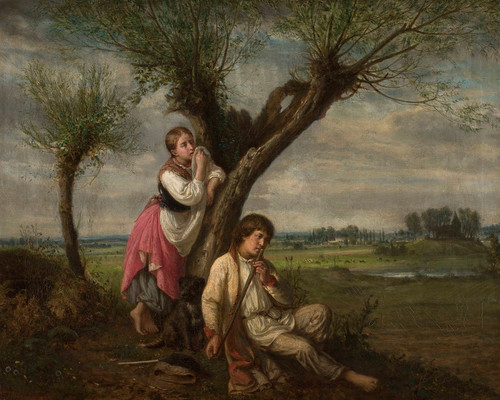
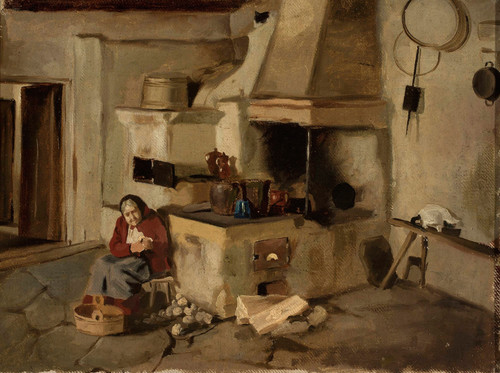
Aleksander Kotsis's "In the farmyard" (1873) occupies a pivotal position within the Realist movement, where the artist's preoccupation with capturing the mundane and everyday coalesced with an unprecedented level of technical proficiency. The impasto brushwork imbues the scene with a textured vitality, as if the very soil and hay have been excavated from the canvas itself. By juxtaposing the earthy tones of the rustic backdrop against the muted greens and browns of the farmhands' clothing, Kotsis creates an atmospheric weight that simultaneously grounds and elevates the viewer's gaze.
At a scale equivalent to 72x44, "In the farmyard" reveals its architectural underpinnings, where spatial rhythm is mediated by the interplay between the farmhouse, barn, and surrounding vegetation. The chromatic structure of earthy tones and muted greens assumes a more pronounced role in establishing an introspective atmosphere, while accents of reds and whites from the figures' clothing inject a sense of vitality into the scene. When paired with materials such as weathered stone or reclaimed wood, these colors would amplify the spatial impact, drawing attention to the nuances of light that dance across the textures. As it interacts with lighting, "In the farmyard" assumes a mediating role between material and atmosphere, its impasto technique lending an almost palpable tactility to the visual experience, thereby underscoring the interior space's relationship to both the surrounding landscape and the artwork itself.
The spatial depth of Kotsis's composition would unfold like a tapestry, inviting viewers to navigate its layered structure. In a luxury interior environment, this could be achieved by aligning materials such as hand-hewn wood or rough-hewn stone with the palette's earthy undertones, thus creating an immersive atmosphere that dissolves the boundaries between artwork and space. As light traverses these textures, it would imbue "In the farmyard" with a sense of luminosity that harmonizes with the surrounding environment, producing an equilibrium of materiality and atmospherics.
This edition adapts fluidly across contemporary interior profiles, offering a stable architectural anchor.
Architectural Behavior
Its horizontal span reinforces axial movement across long architectural planes.
This edition functions as a 72x44 interior anchor, shaping spatial rhythm and establishing a stable visual cadence within the surrounding architecture.
Its chromatic structure responds to natural and artificial lighting, modulating depth and atmospheric weight throughout the day.
Recommended material pairings include natural oak, brushed metal, matte stone composites, and textured linen surfaces.
Gallery Edition Specifications
- Format: 72" x 44" Interior Architectural Study
- Medium: 330gsm Ultra-Premium Fine Art Matte
- Ink System: Wide-gamut archival pigment curation
- Mounting: Delivered unframed for professional gallery installation
Each edition is prepared to order. Gallery-standard quality control requires 3 to 5 business days.