Curatorial Narrative
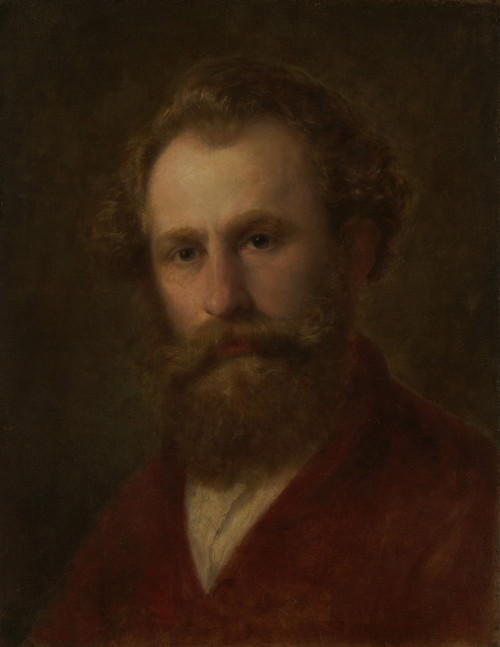
Aleksander Mroczkowski's "Self-portrait" (1903) occupies a pivotal position within the trajectory of modern realism. The artist's masterful employment of impasto brushwork imbues the painting with an almost palpable tactile quality, as if the subject's very essence has been distilled onto the canvas through layers of viscous pigment. Against the somber dark backdrop, Mroczkowski's visage is rendered in earthy tones that evoke a sense of grounding and temporal stasis.
When enlarged to 44x56 inches, "Self-portrait" becomes a commanding presence within a luxury interior environment. The palette assumes a heightened level of chromatic structure, with the somber dark background exerting an almost gravitational pull on adjacent materials. In a space where rich textures are paramount, such as a bespoke library or study, Mroczkowski's impasto technique will engage with sumptuous fabrics and leathers in a dynamic interplay of tactile and visual contrasts. The spatial rhythm established by the painting's deep planes and negative spaces will also inform lighting strategies, with pools of warm illumination casting an atmospheric weight that harmonizes with the rich tones on view.
The enlarged scale reveals Mroczkowski's profound understanding of the relationship between painterly structure and spatial depth. As the subject appears to step out from the canvas, his presence will be amplified by strategic placement within a carefully curated interior landscape. The dark background, once a subtle nuance, now becomes an active element in shaping the viewer's experience, as if drawing the eye inexorably towards the artist's introspective visage.
In this elevated context, "Self-portrait" assumes its full status as a designed object, exerting a profound influence on material pairing and spatial impact. The painting will engage with its surroundings through a complex interplay of texture, tone, and atmospheric weight, ultimately imbuing the luxury interior environment with an added layer of depth, nuance, and historical gravitas.
In terms of specific materials, Mroczkowski's palette is likely to be drawn towards rich leathers, velvets, or intricately patterned rugs that can engage with its earthy tones. In a space where lighting is carefully calibrated, the painting will be further illuminated by strategically placed sconces or floor lamps, which in turn will amplify its atmospheric weight and chromatic structure.
Ultimately, "Self-portrait" (1903) presents itself as an exemplary model of modern realism, replete with a rich interplay of texture, tone, and spatial depth.
This edition's spatial clarity and controlled palette align naturally with modernist interiors.
Architectural Behavior
Its vertical rise introduces a stabilizing architectural counterpoint.
This edition functions as a 44x56 interior anchor, shaping spatial rhythm and establishing a stable visual cadence within the surrounding architecture.
Its chromatic structure responds to natural and artificial lighting, modulating depth and atmospheric weight throughout the day.
Recommended material pairings include natural oak, brushed metal, matte stone composites, and textured linen surfaces.
Gallery Edition Specifications
- Format: 44" x 56" Interior Architectural Study
- Medium: 330gsm Ultra-Premium Fine Art Matte
- Ink System: Wide-gamut archival pigment curation
- Mounting: Delivered unframed for professional gallery installation
Each edition is prepared to order. Gallery-standard quality control requires 3 to 5 business days.