Curatorial Narrative
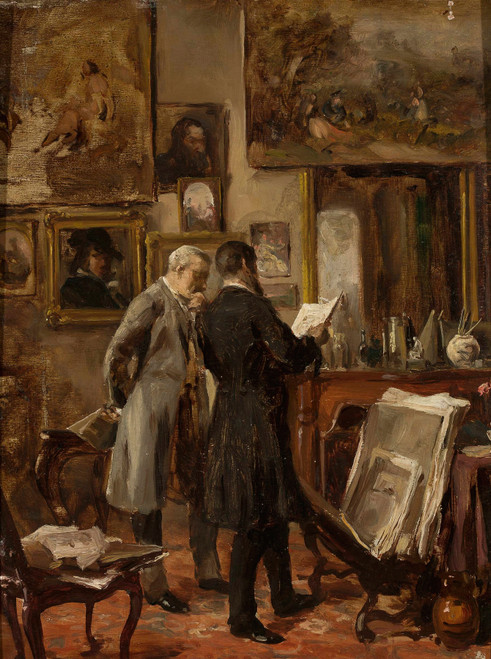
In the realm of classical realism, Aleksander Stankiewicz's "Portrait of Julian Ursyn Niemcewicz" (1842) stands as a testament to the Polish artist's mastery of capturing the subtleties of human presence within a rigorous formal framework. Stankiewicz's brushwork is characterized by softness, imbuing the subject with an air of quiet introspection, while his palette, reliant on neutral tones and muted earthy hues, conjures a sense of atmospheric weight that grounds the figure firmly in the space.
When enlarged to a substantial scale, such as 44x59, the chromatic structure of the portrait assumes a more commanding presence. The spatial rhythm established by Stankiewicz's compositional structure, with its calculated balance between figural and negative space, begins to assert itself as a governing principle within the interior environment. The muted palette, though initially reserved, starts to interact with surrounding materials in ways both subtle and profound. For instance, the gentle sheen of a polished wood floor or the soft glow of a table lamp might begin to resonate with the atmospheric weight of the painting's earthy tones, creating an almost symbiotic relationship between material and image.
The subject's gaze, meanwhile, becomes increasingly deliberate as the viewer approaches the scale of 44x59. The spatial depth established by Stankiewicz's use of chiaroscuro begins to unfold like a narrative in miniature, drawing the observer into the introspective world of the figure. In this regard, the painting behaves rather like a designed object, its various elements – brushwork, palette, and compositional structure – coalescing to create an experience that is at once intimate and expansive.
The spatial impact of the portrait, too, becomes more pronounced as the scale increases. The calculated balance between figural and negative space begins to exert a subtle influence on the surrounding environment, subtly recalibrating the viewer's perception of depth and volume within the room. This effect, while perhaps not immediately apparent at smaller scales, serves to underscore the painting's status as a carefully crafted object with its own unique temporal and spatial dynamics.
In luxury interior environments, where materials are often prized for their tactile qualities and visual allure, Stankiewicz's portrait assumes a particularly nuanced role. The neutral palette, though understated, provides an unobtrusive backdrop for the rich textures and subtle sheens of surrounding materials to assert themselves. At the same time, the painting's atmospheric weight serves as a reminder that even in the most refined environments, there lies a depth – both physical and emotional – waiting to be explored.
The interplay between material and image becomes especially pronounced when paired with certain types of furnishings or architectural features. For instance, the muted earthy hues of the portrait might find a sympathetic resonance in the warm tones of a hand-finished wood floor or the soft patina of an antique metalwork piece. Conversely, the painting's atmospheric weight could serve as a counterpoint to more dramatic lighting effects or bold material juxtapositions, creating a dynamic tension that rewards close observation and careful consideration.
Ultimately, Stankiewicz's "Portrait of Julian Ursyn Niemcewicz" (1842) serves as a powerful reminder of the enduring importance of classical realism in capturing the subtleties of human presence. At an enlarged scale of 44x59, the painting's chromatic structure, spatial rhythm, and compositional structure assume a commanding presence within the interior environment, inviting close observation and careful consideration from both artist and viewer alike.
The refined sensibilities of high-end interior designers are likely to appreciate the nuanced interplay between material and image in Stankiewicz's portrait. By carefully selecting complementary materials and lighting
This edition's spatial clarity and controlled palette align naturally with modernist interiors.
Architectural Behavior
Its vertical rise introduces a stabilizing architectural counterpoint.
This edition functions as a 44x59 interior anchor, shaping spatial rhythm and establishing a stable visual cadence within the surrounding architecture.
Its chromatic structure responds to natural and artificial lighting, modulating depth and atmospheric weight throughout the day.
Recommended material pairings include natural oak, brushed metal, matte stone composites, and textured linen surfaces.
Gallery Edition Specifications
- Format: 44" x 59" Interior Architectural Study
- Medium: 330gsm Ultra-Premium Fine Art Matte
- Ink System: Wide-gamut archival pigment curation
- Mounting: Delivered unframed for professional gallery installation
Each edition is prepared to order. Gallery-standard quality control requires 3 to 5 business days.