Curatorial Narrative
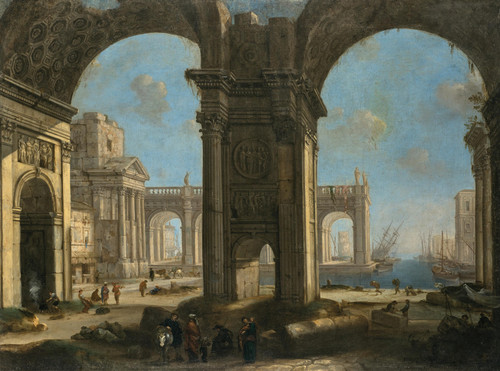
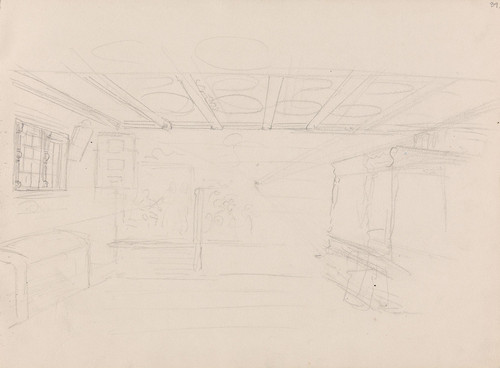
Alessandro Sanquirico's Interior of a Stateroom with Four Tables Displaying Urns and Tabernacles is a paradigmatic example of Neoclassical painting, embodying the era's fascination with ancient architecture and decorative arts. Created in an unspecified year, likely within the 18th century, this work exemplifies the artist's mastery of fine brushwork, as seen in the delicate rendering of marble surfaces and intricately patterned textiles.
The monochromatic palette, comprising a range of grayscale tones with varying shades of gray, imbues the stateroom with an atmosphere of serene elegance. Sanquirico's use of chiaroscuro creates a spatial rhythm that guides the viewer through the composition, drawing attention to the central axis and the ornate tabernacles. As this work is scaled up to 59x44 inches, its chromatic structure assumes a more pronounced significance, influencing the material pairing and lighting behavior within a luxury interior environment.
As the artwork's atmospheric weight deepens, it becomes clear that Sanquirico's design was conceived not merely as a representation of architectural space but also as an exemplar of Renaissance Revival aesthetics. The Classical motifs and forms present in the tabernacles and urns assume a more pronounced presence when enlarged, interacting with surrounding materials to create a sense of cohesion and refinement.
The interplay between light and spatial depth assumes greater importance at this scale, with the artist's use of chiaroscuro imbuing the stateroom with an air of luminosity that is both contained and expansive. In a luxury interior setting, Sanquirico's Interior would pair harmoniously with materials such as travertine, Carrara marble, or polished bronze, while its muted color palette would allow for judicious use of lighting to enhance the spatial drama and create areas of visual focus.
The compositional structure of the painting assumes a more active role in shaping the viewer's experience at larger scales. The artist's deliberate placement of focal points – such as the central tabernacle – guides the eye through the space, while the surrounding architectural elements provide context for the decorative arts on display. As an exemplar of Neoclassical design, Sanquirico's Interior of a Stateroom offers a nuanced exploration of spatial relationships and material interplay.
In terms of its impact on a luxury interior environment, Sanquirico's work would contribute to a sense of refinement and sophistication, encouraging the selection of materials and finishes that complement its muted yet luminous aesthetic.
This edition adapts fluidly across contemporary interior profiles, offering a stable architectural anchor.
Architectural Behavior
Its horizontal span reinforces axial movement across long architectural planes.
This edition functions as a 59x44 interior anchor, shaping spatial rhythm and establishing a stable visual cadence within the surrounding architecture.
Its chromatic structure responds to natural and artificial lighting, modulating depth and atmospheric weight throughout the day.
Recommended material pairings include natural oak, brushed metal, matte stone composites, and textured linen surfaces.
Gallery Edition Specifications
- Format: 59" x 44" Interior Architectural Study
- Medium: 330gsm Ultra-Premium Fine Art Matte
- Ink System: Wide-gamut archival pigment curation
- Mounting: Delivered unframed for professional gallery installation
Each edition is prepared to order. Gallery-standard quality control requires 3 to 5 business days.