Curatorial Narrative
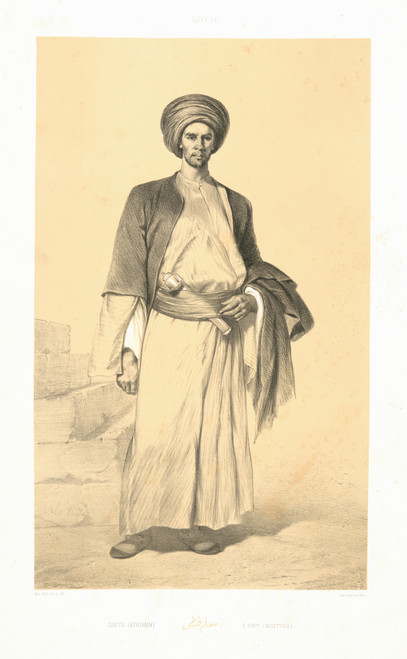
In the 1850s, Alexandre Bida's oeuvre was marked by an unyielding commitment to realism, one that set him apart from his contemporaries. "Femme Fellâh du Caire" exemplifies this preoccupation with accuracy, as he sought to capture the essence of a particular time and place. The linear brushwork employed here serves to underscore the artist's dedication to rendering the physical world in unvarnished detail.
The subject, seated on a woven mat amidst the bustling streets of Cairo, assumes an air of quiet contemplation. Her features are rendered with subtlety, their contours softened by the neutral tones that predominate throughout the palette. Sepia and beige hues imbue the scene with a sense of aged patina, as if the very atmosphere itself had been infused with the weight of history.
In its enlarged state, "Femme Fellâh du Caire" assumes an imposing presence, its 44x71 format serving to underscore the spatial rhythm established by Bida's design. The chromatic structure, initially characterized by a predominance of neutral tones, gives way to a more nuanced interplay of warm and cool hues as the eye moves across the surface. This expansion also serves to emphasize the atmospheric weight of the scene, with shadows cast across the subject's face and the surrounding architecture.
As "Femme Fellâh du Caire" is enlarged, its influence on a luxury interior environment becomes increasingly pronounced. The neutral tones that predominate throughout the palette lend themselves readily to pairing with rich, textured materials – velvet drapery, intricately patterned rugs, or even antique stone flooring – while the sepia and beige hues recall the patina of aged wood or metal. Lighting behavior is also significantly impacted, as the warm tones of a carefully placed pendant lamp or the gentle glow of table lamps serve to underscore the subject's quiet dignity.
In this scale, the spatial impact of "Femme Fellâh du Caire" becomes more overtly architectural, its influence extending beyond the confines of the frame. The subject's placement within the composition serves as a reminder that even the most intimate spaces are not immune to the influences of the external world – the bustle of Cairo's streets, in this case. This tension between interior and exterior is one that luxury interiors must continually navigate, seeking to balance the competing demands of comfort and cultural significance.
The architectural behavior of "Femme Fellâh du Caire" when enlarged serves as a testament to Bida's skill as a draftsman and his deep understanding of the spatial relationships that govern our surroundings. It stands as a reminder that even in the most intimate spaces, there exists a profound connection between the physical world and the cultural artifacts that populate it.
This edition adapts fluidly across contemporary interior profiles, offering a stable architectural anchor.
Architectural Behavior
Its vertical rise introduces a stabilizing architectural counterpoint.
This edition functions as a 44x71 interior anchor, shaping spatial rhythm and establishing a stable visual cadence within the surrounding architecture.
Its chromatic structure responds to natural and artificial lighting, modulating depth and atmospheric weight throughout the day.
Recommended material pairings include natural oak, brushed metal, matte stone composites, and textured linen surfaces.
Gallery Edition Specifications
- Format: 44" x 71" Interior Architectural Study
- Medium: 330gsm Ultra-Premium Fine Art Matte
- Ink System: Wide-gamut archival pigment curation
- Mounting: Delivered unframed for professional gallery installation
Each edition is prepared to order. Gallery-standard quality control requires 3 to 5 business days.