Curatorial Narrative
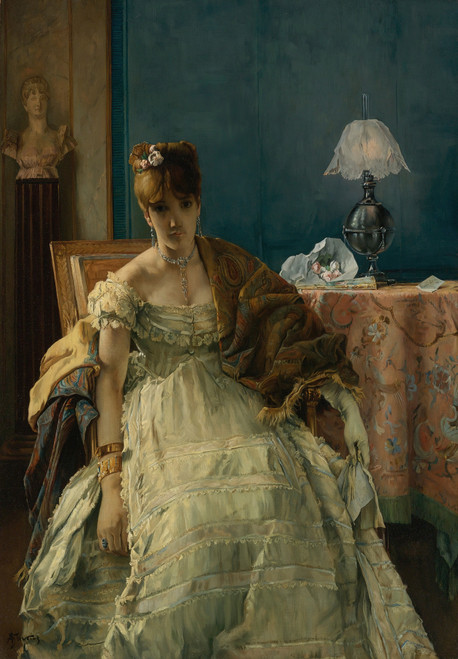
In the tradition of Victorian-era portraiture, Alfred H. Wall's "Mrs. Hartley as 'Rosamund' in 'Henry II'" exemplifies the artist's technical facility and adherence to established conventions. Created during an era when artistic expression was often tempered by social protocol, this work presents a deliberate marriage of style and subject matter. The linear brushwork, characteristic of the period, imbues the composition with a sense of restraint, underscoring the sitters' dignified demeanor.
The monochromatic palette, a hallmark of Victorian portraiture, lends an air of gravitas to the scene, while also allowing the artist to focus on nuanced explorations of light and shadow. As the subject's face is set against a richly textured backdrop, the spatial rhythm established by the Gothic Revival-inspired design elements subtly reinforces the overall sense of atmospheric weight. Enlarged to 44x63 inches, this print assumes an imposing presence within a luxury interior environment, its dark tones drawing attention to strategic pairings of materials – for example, the polished finish of a console table or the lustrous sheen of a silk wallcovering.
As "Mrs. Hartley as 'Rosamund' in 'Henry II'" occupies a prominent space, its chromatic structure begins to interact with the ambient lighting conditions within the room. In areas where direct illumination falls, the high-contrast relationship between light and shadow creates a visual depth that appears almost three-dimensional, imbuing the scene with an added layer of sculptural presence. Conversely, in regions where diffused light dominates, the overall sense of atmospheric weight is heightened, drawing attention to the richly detailed textures of adjacent surfaces.
The architectural scale of this print also prompts consideration of its relationship to adjacent spatial elements within a luxury interior environment. When placed above a console table or fire surround, for instance, "Mrs. Hartley as 'Rosamund' in 'Henry II'" engages with adjacent design features through a dynamic interplay of line and mass. This heightened sense of visual tension underscores the print's capacity to contribute meaningfully to the spatial narrative within such environments, its carefully calibrated balance of light and shadow imbuing surrounding spaces with an added layer of psychological resonance.
Within a more subdued interior context, this print assumes a meditative quality, its dark tones serving as a backdrop for contemplative reflection. As ambient lighting levels shift or alter throughout the day, "Mrs. Hartley as 'Rosamund' in 'Henry II'" engages with adjacent spaces through an intricate web of visual relationships, reinforcing the notion that even within the most refined interior environments, the capacity to engage and inspire lies within the realm of artistic expression itself.
The spatial structure established by this print – its deliberate balance of line and mass, coupled with a nuanced exploration of light and shadow – also assumes significant importance when considered in conjunction with adjacent design elements. For instance, in areas where the print is juxtaposed with intricately patterned textiles or ornate plasterwork, its carefully calibrated visual relationships reinforce an overall sense of aesthetic cohesion.
Ultimately, "Mrs. Hartley as 'Rosamund' in 'Henry II'" assumes a unique place within the broader context of Victorian portraiture, distinguished by its deliberate adherence to established conventions even as it subtly subverts them through its nuanced exploration of light and shadow. As this print occupies an expanded space within a luxury interior environment – whether through enlargement or strategic placement – its carefully calibrated balance of line and mass continues to engage with adjacent design elements in a dynamic interplay of visual tension and spatial resonance.
The architectural scale of "Mrs. Hartley as 'Rosamund' in 'Henry II'" prompts consideration of its capacity to interact meaningfully
This edition adapts fluidly across contemporary interior profiles, offering a stable architectural anchor.
Architectural Behavior
Its vertical rise introduces a stabilizing architectural counterpoint.
This edition functions as a 44x63 interior anchor, shaping spatial rhythm and establishing a stable visual cadence within the surrounding architecture.
Its chromatic structure responds to natural and artificial lighting, modulating depth and atmospheric weight throughout the day.
Recommended material pairings include natural oak, brushed metal, matte stone composites, and textured linen surfaces.
Gallery Edition Specifications
- Format: 44" x 63" Interior Architectural Study
- Medium: 330gsm Ultra-Premium Fine Art Matte
- Ink System: Wide-gamut archival pigment curation
- Mounting: Delivered unframed for professional gallery installation
Each edition is prepared to order. Gallery-standard quality control requires 3 to 5 business days.