Curatorial Narrative
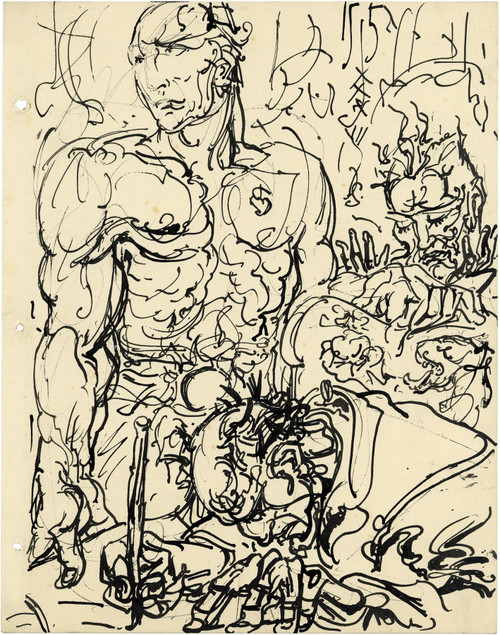
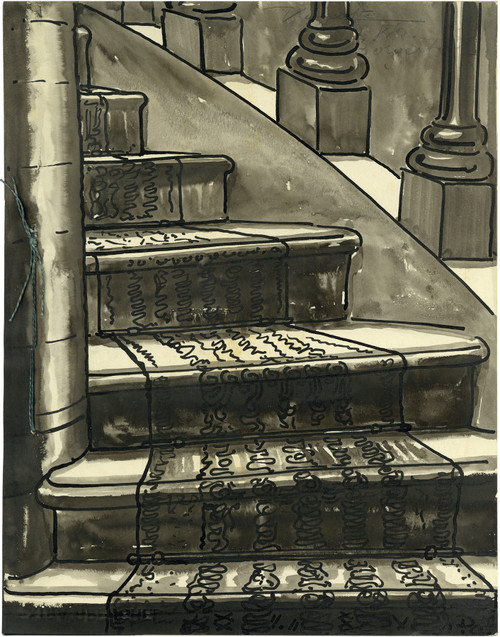
In the midst of the interwar period, Alfred Ost's Drie gezichten in zijprofiel (1935) embodies the fervent experimentation characteristic of Expressionist art. The artist's brushwork is marked by a fine, almost filigree-like precision, as if attempting to capture the very essence of his subjects. Here, Ost eschews traditional representational forms for an abstracted, modernist vocabulary, one that privileges the inherent expressive qualities of paint itself over narrative or illustrative purposes.
As Drie gezichten in zijprofiel is scaled up to 44x56 inches, its chromatic structure begins to exert a profound influence on its surroundings. The stark black and white palette assumes an almost sculptural quality, imbuing the space with a subtle atmospheric weight that resonates through the materiality of the walls and furniture. The spatial rhythm established by Ost's composition – a gentle interplay between rectangular forms and negative space – proves remarkably adaptable to interior environments, allowing it to effortlessly integrate with a range of architectural styles while exerting its own distinct influence on the overall spatial dynamics.
The fine brushwork evident throughout Drie gezichten in zijprofiel lends itself particularly well to strategic lighting, which can be employed to further emphasize the intricate textures and tonal nuances that underpin Ost's abstracted forms. When paired with suitably minimalist furnishings – perhaps a low-profile sofa or a pair of sleek armchairs – the artwork assumes an almost monolithic presence within the room, its visual gravity drawing the viewer's eye inexorably towards its central axis.
In terms of material pairing, Drie gezichten in zijprofiel can be effectively juxtaposed with a variety of textures and finishes, from the cool sheen of polished steel or glass to the warm, tactile quality of wood or woven fibers. Such combinations not only create a visually striking contrast but also serve to underscore the artwork's own inherent materiality, drawing attention to the ways in which Ost's paint interacts with – and is, in turn, shaped by – its surroundings.
Ultimately, Drie gezichten in zijprofiel functions as a masterful exemplar of Expressionist art, one that continues to exert a profound influence on contemporary visual culture. Its modern, almost austere aesthetic belies a rich, nuanced complexity, inviting the viewer to engage with its multifaceted structure and atmospheric depth through a series of subtle, interlocking gestures.
When viewed in close proximity, Drie gezichten in zijprofiel's brushstrokes assume an almost kinetic quality, their delicate ridges and furrows imbuing the artwork with a sense of dynamic tension that is both captivating and thought-provoking. This, in turn, creates a unique spatial dynamic within the room, one in which the viewer is drawn into a dialogue between the artwork's visual structure and the surrounding environment.
Drie gezichten in zijprofiel's abstracted forms also lend themselves particularly well to strategic placement within a luxury interior environment, where their clean lines and modernist aesthetic can be employed to create a sense of visual flow and cohesion. By carefully positioning the artwork within a larger spatial matrix – perhaps in conjunction with other works by Ost or his contemporaries – it is possible to create a truly immersive environment, one that draws the viewer into its complex, interlocking structure through a series of subtle, almost imperceptible gestures.
By virtue of its size and scale, Drie gezichten in zijprofiel assumes a commanding presence within the room, its abstracted forms exerting a profound influence on the surrounding space. The artwork's fine brushwork and stark palette imbue it with an almost sculptural quality, one that is both visually striking and thought-pro
This edition's spatial clarity and controlled palette align naturally with modernist interiors.
Architectural Behavior
Its vertical rise introduces a stabilizing architectural counterpoint.
This edition functions as a 44x56 interior anchor, shaping spatial rhythm and establishing a stable visual cadence within the surrounding architecture.
Its chromatic structure responds to natural and artificial lighting, modulating depth and atmospheric weight throughout the day.
Recommended material pairings include natural oak, brushed metal, matte stone composites, and textured linen surfaces.
Gallery Edition Specifications
- Format: 44" x 56" Interior Architectural Study
- Medium: 330gsm Ultra-Premium Fine Art Matte
- Ink System: Wide-gamut archival pigment curation
- Mounting: Delivered unframed for professional gallery installation
Each edition is prepared to order. Gallery-standard quality control requires 3 to 5 business days.