Curatorial Narrative
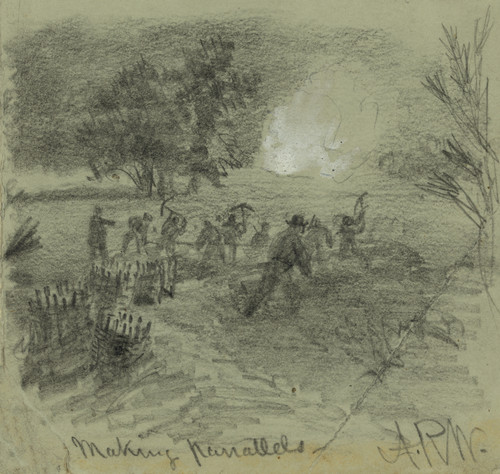
Alfred Rudolph Waud's "Building military bridges. Making charcoal for the army force" occupies a pivotal position within the realist tradition of mid-nineteenth-century American art, marking an era in which the country was grappling with the tumultuous aftermath of the Mexican-American War and the burgeoning conflict with the Confederacy. Executed between 1860-1865, Waud's work falls squarely within this turbulent historical context, yet its formal qualities are characterized by a measured restraint that belies the chaos unfolding across the nation.
The artist's masterful deployment of fine brushwork imbues the composition with an understated dynamism, as delicate wisps of smoke and subtle gradations in tonal value create a sense of spatial rhythm that oscillates between depth and flatness. Neutral tones predominate here, punctuated by judicious deployments of brown and beige hues that underscore the utilitarian function of these military endeavors. As the composition unfolds at an enlarged scale – say 51x44 – the chromatic structure begins to assert its presence, with earthy tones yielding a surprisingly warm and subdued atmosphere.
The spatial impact is notable in this regard, as the composition's minimalist design styles seem almost willfully at odds with the imposing subject matter. A luxury interior environment might respond to these qualities by pairing rich textures – such as hand-woven wools or supple leathers – with Waud's palette of muted tones, yielding a contemplative atmosphere that encourages the viewer to slow their pace and immerse themselves in the work's carefully calibrated spatial rhythms.
In lighting terms, a pendant fixture suspended above a low-slung console table might cast dappled shadows across the floor, evoking the hazy atmospheric weight that pervades Waud's composition. The effect would be one of measured grandeur, as if the space itself had been subsumed by the quiet, unassuming dignity of the military operations depicted in the painting.
Material pairing is another critical consideration, with a possible response being to pair smooth expanses of wood or stone with the coarse, tactile quality of woven canvas or linen. The resulting interplay between surface and texture would create a richly nuanced environment that rewards close attention and invites the viewer to immerse themselves within Waud's carefully constructed world.
Ultimately, it is this very quietude – this measured restraint in the face of turmoil – that lends "Building military bridges. Making charcoal for the army force" its enduring power, as if the painting itself were a testament to the enduring legacy of American ingenuity and determination in the face of adversity.
This edition's spatial clarity and controlled palette align naturally with modernist interiors.
Architectural Behavior
Its horizontal span reinforces axial movement across long architectural planes.
This edition functions as a 51x44 interior anchor, shaping spatial rhythm and establishing a stable visual cadence within the surrounding architecture.
Its chromatic structure responds to natural and artificial lighting, modulating depth and atmospheric weight throughout the day.
Recommended material pairings include natural oak, brushed metal, matte stone composites, and textured linen surfaces.
Gallery Edition Specifications
- Format: 51" x 44" Interior Architectural Study
- Medium: 330gsm Ultra-Premium Fine Art Matte
- Ink System: Wide-gamut archival pigment curation
- Mounting: Delivered unframed for professional gallery installation
Each edition is prepared to order. Gallery-standard quality control requires 3 to 5 business days.