Curatorial Narrative
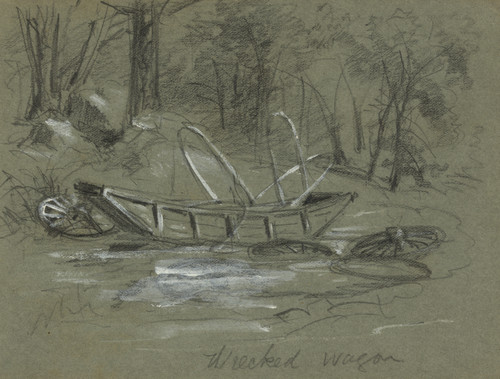
The Jobe house. Ringgold, Ga., by Alfred Rudolph Waud, executed in 1864, occupies a pivotal position within the artist's oeuvre and the broader visual lexicon of the American Civil War era. Characterized by a fine brushwork that imbues the scene with an air of serenity, the painting presents a studied composition, wherein the artist's deliberate deployment of neutral tones – beige and gray predominate – serves to underscore the structural integrity of the subject.
Upon enlargement to 58x44, the spatial rhythm of the work becomes more pronounced, as the atmospheric weight of the scene shifts subtly. The chromatic structure, initially monochromatic in tone, begins to reveal a nuanced interplay between warm and cool hues, which, in turn, influences the material pairing within a luxury interior environment. In this scale, the painting's spatial depth appears almost sculptural, inviting consideration of how such a treatment might be replicated through strategic placement of architectural elements and selective use of natural light.
The artist's attention to atmospheric detail is particularly noteworthy, as it contributes to an overall sense of stillness that pervades the scene. The carefully modulated brushstrokes – so fine as to verge on the impalpable – imbue the structure with a palpable presence, inviting the viewer to contemplate its proportions and spatial relationships.
In interior contexts, such a work would likely be paired with materials of like tactile and chromatic sensibility: weathered woods, matte-finish surfaces, and subtle upholstery tones that echo the beige and gray palette. The painting's structural integrity would be reinforced by strategic placement within a room – ideally near a window – where its spatial rhythms could be harmonized with the surrounding environment through judicious use of natural light.
The artist's deployment of neutral tones serves not only to underscore the subject's structural integrity but also to create a sense of visual equilibrium. This quality, in turn, allows for a heightened appreciation of the painting's underlying structure – a complex interplay of lines, planes, and volumes that lend the scene its spatial coherence.
In this scale, the work's chromatic structure begins to reveal subtle undertones, which, when paired with judicious use of natural light, can imbue an interior space with a sense of depth and visual interest. The artist's masterful manipulation of atmospheric weight – achieved through deliberate deployment of brushstrokes and pigment – creates a palpable presence that invites the viewer to contemplate its structural relationships.
The spatial rhythms established by Waud in this work would be ideally suited for pairing with minimalist architectural elements, such as clean-lined shelving or low-profile furniture. The artist's careful attention to atmospheric detail would also suggest the use of subtle light sources – e.g., recessed downlights or strategically placed sconces – to create a sense of visual equilibrium within the space.
In interior contexts, this work would likely be paired with materials and finishes that echo its beige and gray palette: matte-finish surfaces, weathered woods, and subtle upholstery tones. The artist's structural relationships would also suggest strategic placement near a window, where natural light could harmonize with the surrounding environment through judicious use of spatial rhythms.
The painting's spatial integrity – established through Waud's deliberate deployment of brushstrokes and pigment – creates a sense of visual equilibrium that invites consideration of how such a treatment might be replicated within an interior space. The artist's masterful manipulation of atmospheric weight, in turn, allows for a heightened appreciation of the underlying structure – a complex interplay of lines, planes, and volumes that lend the scene its spatial coherence.
The artist's deployment of fine brushwork imbues the scene with an air of serenity, underscoring the
This edition adapts fluidly across contemporary interior profiles, offering a stable architectural anchor.
Architectural Behavior
Its horizontal span reinforces axial movement across long architectural planes.
This edition functions as a 58x44 interior anchor, shaping spatial rhythm and establishing a stable visual cadence within the surrounding architecture.
Its chromatic structure responds to natural and artificial lighting, modulating depth and atmospheric weight throughout the day.
Recommended material pairings include natural oak, brushed metal, matte stone composites, and textured linen surfaces.
Gallery Edition Specifications
- Format: 58" x 44" Interior Architectural Study
- Medium: 330gsm Ultra-Premium Fine Art Matte
- Ink System: Wide-gamut archival pigment curation
- Mounting: Delivered unframed for professional gallery installation
Each edition is prepared to order. Gallery-standard quality control requires 3 to 5 business days.