Curatorial Narrative
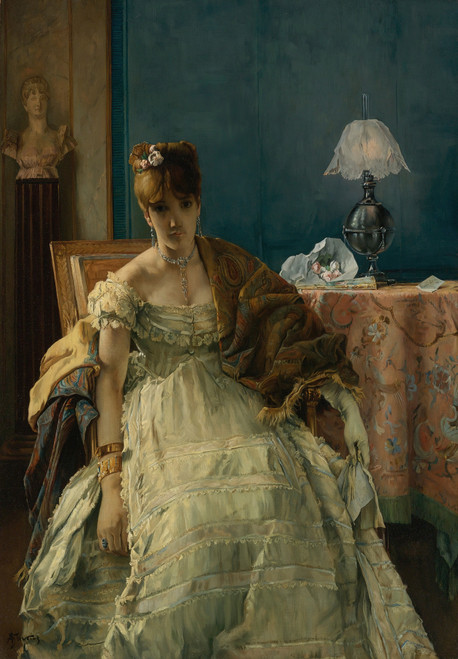
In the context of late 19th-century Impressionism, Alfred Stevens' "Un Bleuet" occupies a unique position, oscillating between the somber introspection characteristic of Victorian art and the lighthearted joie de vivre associated with French Country aesthetics. Painted in 1866, this work coincides with a pivotal moment in Stevens' career, as he transitioned from his earlier Realist inclinations to a more fluid, expressive style.
The artist's technique here is notable for its deliberate use of impasto, which imbues the subject with a tactile, almost three-dimensional quality. The palette, dominated by white and blue, creates an ethereal atmosphere that invites contemplation. At first glance, the composition appears to be a simple still life, but closer inspection reveals a sophisticated spatial rhythm, with the flowers and foliage arranged in a manner that evokes a sense of movement and fluidity.
As the piece is enlarged to 44x63, its chromatic structure takes on greater significance. The blue ribbon that gives the work its title becomes a focal point, drawing the viewer's eye through the composition and into the depths of the painting. In a luxury interior environment, this would create an interesting dynamic, with the cool tone of the blue ribbon providing a subtle contrast to warmer materials like wood or stone.
The spatial depth achieved through Stevens' use of atmospheric perspective is particularly noteworthy in this scale. The flowers appear to recede into the background, creating a sense of distance and encouraging the viewer to engage with the space beyond the painting's surface. In an interior design context, this would pair well with materials that create a sense of texture and tactility, such as woven rugs or upholstered furniture.
The atmospheric weight of "Un Bleuet" is also notable in its ability to modulate light. As it absorbs and reflects different wavelengths, the piece appears to shift and change color in response to changing lighting conditions. In an interior environment, this would be an attractive quality, allowing the painting to integrate seamlessly with surrounding decor while maintaining a unique presence.
In terms of material pairing, "Un Bleuet" would pair well with natural materials like wood or stone, which would complement its earthy, organic feel. However, it would also work effectively in a space dominated by metallic or glass elements, where its cool tone and sense of calm would provide a welcome respite from the reflective surfaces.
Ultimately, the presence of "Un Bleuet" in a luxury interior environment would add a layer of sophistication and refinement, its subtle color palette and intricate spatial structure creating an atmosphere that is both contemplative and engaging.
This edition adapts fluidly across contemporary interior profiles, offering a stable architectural anchor.
Architectural Behavior
Its vertical rise introduces a stabilizing architectural counterpoint.
This edition functions as a 44x63 interior anchor, shaping spatial rhythm and establishing a stable visual cadence within the surrounding architecture.
Its chromatic structure responds to natural and artificial lighting, modulating depth and atmospheric weight throughout the day.
Recommended material pairings include natural oak, brushed metal, matte stone composites, and textured linen surfaces.
Gallery Edition Specifications
- Format: 44" x 63" Interior Architectural Study
- Medium: 330gsm Ultra-Premium Fine Art Matte
- Ink System: Wide-gamut archival pigment curation
- Mounting: Delivered unframed for professional gallery installation
Each edition is prepared to order. Gallery-standard quality control requires 3 to 5 business days.