Curatorial Narrative
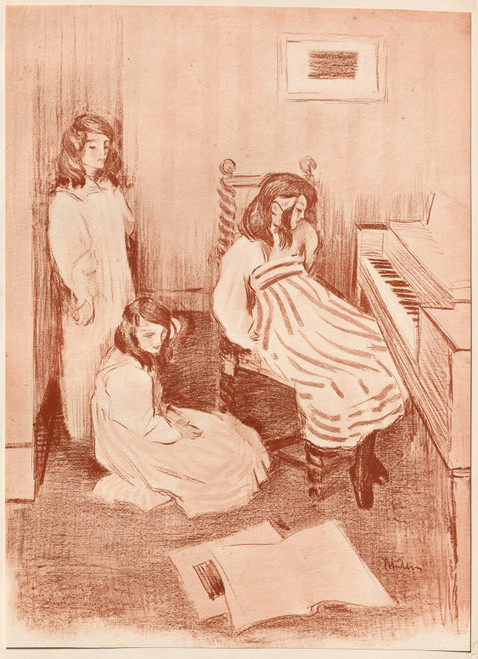
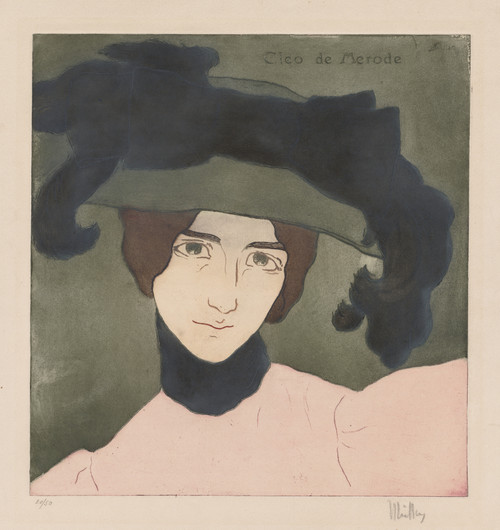
Alfredo Müller's "Dante au lys ou Incipit Vita nova" exemplifies the nascent Expressionist movement of late 19th-century Europe. Executed in 1898, this work embodies the stylistic oscillations characteristic of this period, as artists sought to reconcile representational concerns with the burgeoning avant-garde.
The artist's linear brushwork and deliberate application of black and white tones create a staccato effect, drawing attention to the spatial rhythm of the composition. Against this stark backdrop, splashes of vibrant orange imbue the subject with an aura of dynamic tension. This chromatic structure finds its corollary in the Art Deco motifs that would come to dominate interior design in the decades following.
The spatial depth achieved through Müller's use of atmospheric perspective adds weight and gravitas to the composition, underscoring the sense of grandeur inherent in the subject matter. When enlarged to 44x57, this work assumes a commanding presence within a luxury interior environment, its dark tones absorbing and concentrating the surrounding light. The linear structure of the brushwork can be seen as an echo of the Modernist ideals that would soon come to dominate architectural discourse.
In a material pairing with rich, dark woods or metallic accents, Müller's painting will draw attention to the tactile qualities of these materials while amplifying its own atmospheric weight. Conversely, when paired with lighter, more reflective surfaces, the work's spatial rhythm and chromatic structure will be heightened, imbuing the surrounding space with an increased sense of visual tension.
The subject's placement within a grand architectural setting can also influence our perception of Müller's painting. When situated above or beside a sweeping staircase, the dynamic tension between the figure and the ornate backdrop is amplified, underscoring the interplay between spatial rhythm and material presence.
Upon enlargement, the linear structure of the brushwork begins to assert its dominance over the surrounding space, creating a sense of visual momentum that propels the viewer through the composition. This kinetic quality can be seen as an extension of Müller's own artistic concerns, which sought to capture the fluidity and dynamism of human experience.
As a designed object within a luxury interior environment, "Dante au lys ou Incipit Vita nova" functions not merely as a decorative element but as a dynamic participant in the surrounding space. Its interaction with light, material, and spatial structure imbues the surrounding environment with an increased sense of visual tension and atmospheric weight.
Ultimately, Müller's painting can be seen as an exemplar of the Expressionist impulse to capture the fluidity and dynamism of human experience within a static medium. By situating this work within a luxury interior environment, we are reminded that even the most austere and modern spaces can benefit from the dynamic tension created by the interplay between light, material, and spatial structure.
In Müller's "Dante au lys ou Incipit Vita nova," we find a compelling example of Expressionist art at its most refined. Executed in 1898, this work stands as a testament to the artist's skill in balancing representational concerns with the avant-garde ideals that would come to dominate early 20th-century art.
The painting's dark tones and linear structure create a staccato effect that draws attention to the spatial rhythm of the composition. This chromatic structure is echoed in the Art Deco motifs that would come to dominate interior design in the decades following, while its atmospheric perspective adds weight and gravitas to the subject matter.
When enlarged to 44x57, Müller's work assumes a commanding presence within a luxury interior environment, its dark tones absorbing and concentrating the surrounding light. The linear structure of the brushwork can be seen as an echo of the Modern
This edition's spatial clarity and controlled palette align naturally with modernist interiors.
Architectural Behavior
Its vertical rise introduces a stabilizing architectural counterpoint.
This edition functions as a 44x57 interior anchor, shaping spatial rhythm and establishing a stable visual cadence within the surrounding architecture.
Its chromatic structure responds to natural and artificial lighting, modulating depth and atmospheric weight throughout the day.
Recommended material pairings include natural oak, brushed metal, matte stone composites, and textured linen surfaces.
Gallery Edition Specifications
- Format: 44" x 57" Interior Architectural Study
- Medium: 330gsm Ultra-Premium Fine Art Matte
- Ink System: Wide-gamut archival pigment curation
- Mounting: Delivered unframed for professional gallery installation
Each edition is prepared to order. Gallery-standard quality control requires 3 to 5 business days.