
Curatorial Narrative
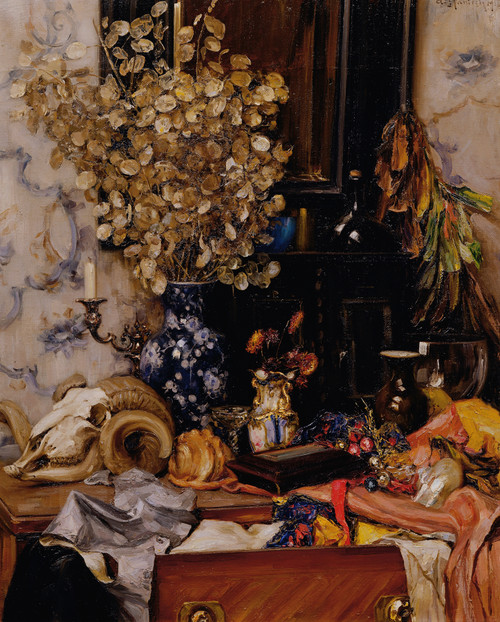
Alois Hänisch's "Stillleben" of 1908 embodies the somber introspection characteristic of late Impressionism. Executed in thick, tactile brushstrokes that imbue the canvas with an almost palpable presence, the painting anchors itself within a visual vocabulary of quiet contemplation. By juxtaposing warm earth tones - rich, burnished browns and golden ochres - against accents of blue and red, Hänisch creates a chromatic structure that navigates the threshold between luminosity and shadow.
When enlarged to 44x54 inches, the painting's composition assumes a commanding presence within its chosen architectural environment. The spatial rhythm established by the artist's use of depth - achieved through layering and atmospheric perspective - assumes an almost sculptural quality. As one considers material pairing, for example, the warm tones of a walnut sideboard or the burnished metal of a bronze vase would complement the painting's earthy palette while establishing a harmonious spatial dialogue. Conversely, cool-toned surfaces such as polished glass or aluminum could disrupt this balance by introducing an incongruous note of brightness.
Its grounded tonal structure complements traditional interiors with quiet sophistication.
Architectural Behavior
Its horizontal span reinforces axial movement across long architectural planes.
This edition functions as a 44x54 interior anchor, shaping spatial rhythm and establishing a stable visual cadence within the surrounding architecture.
Its chromatic structure responds to natural and artificial lighting, modulating depth and atmospheric weight throughout the day.
Recommended material pairings include natural oak, brushed metal, matte stone composites, and textured linen surfaces.
Gallery Edition Specifications
- Format: 44" x 54" Interior Architectural Study
- Medium: 330gsm Ultra-Premium Fine Art Matte
- Ink System: Wide-gamut archival pigment curation
- Mounting: Delivered unframed for professional gallery installation
Each edition is prepared to order. Gallery-standard quality control requires 3 to 5 business days.


