Curatorial Narrative
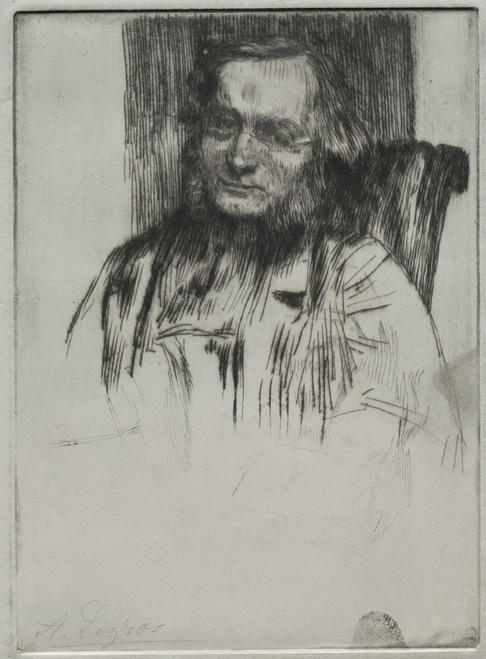
The Study for the hands in the Portrait of Edward D. Adams by Alphonse Legros occupies a pivotal position within late 19th-century art history, exemplifying the artist's mature handling of figurative subject matter through an obsessive attention to detail and a deliberate deployment of modernist visual strategies.
As an exercise in draughtsmanship, this study showcases Legros' linear brushwork, which imbues the composition with an unyielding sense of resolution and control, underscoring the artist's debt to French Realism while simultaneously pointing towards the austere Modernity that was beginning to coalesce on the Continent.
The monochromatic palette, a hallmark of Legros' work during this period, lends an air of sobriety to the study, its predominantly grayscale tones conjuring a sense of atmospheric weight that seems almost palpable. By limiting his color range in this manner, Legros achieves a heightened sense of visual clarity, allowing the viewer's eye to dance across the surface with a precision and ease that is both captivating and unnerving.
When enlarged to 44x59 inches, the study reveals its capacity for monumental presence, its spatial rhythm unfolding like a carefully calibrated sequence of events. In this larger format, the chromatic structure, once a subtle undercurrent, now assumes a dominant role, modulating the atmospheric weight of the composition in ways both intuitive and subliminal.
In a luxury interior environment, the Study for the hands in the Portrait of Edward D. Adams would prove an inspired choice, its austere Modernity offset by judicious pairings of rich materials – polished stone, dark wood, or burnished metal – that would serve to amplify its dramatic impact while subtly underscoring the tension between surface and depth.
The study's minimalist design and monochromatic palette would, in turn, govern the lighting behavior within a given space, casting long shadows that seem to emanate from the very core of the composition itself. As such, it would be crucial to balance this atmospheric weight with an abundance of reflective surfaces – polished glass or mirror-like metalwork – that would serve to diffuse and refract the light, thereby creating a visual dynamic that is at once both captivating and disorienting.
In terms of spatial impact, the study's carefully calibrated structure would dictate the flow of movement within a given room, its rhythmic sequence of forms guiding the viewer's eye towards a destination that is as much physical as it is psychological. In this manner, the Study for the hands in the Portrait of Edward D. Adams assumes a role that is both functional and aesthetic, serving as a visual anchor that can help to mediate the complex interplay between object, space, and observer within even the most luxurious of interior environments.
This edition's spatial clarity and controlled palette align naturally with modernist interiors.
Architectural Behavior
Its vertical rise introduces a stabilizing architectural counterpoint.
This edition functions as a 44x59 interior anchor, shaping spatial rhythm and establishing a stable visual cadence within the surrounding architecture.
Its chromatic structure responds to natural and artificial lighting, modulating depth and atmospheric weight throughout the day.
Recommended material pairings include natural oak, brushed metal, matte stone composites, and textured linen surfaces.
Gallery Edition Specifications
- Format: 44" x 59" Interior Architectural Study
- Medium: 330gsm Ultra-Premium Fine Art Matte
- Ink System: Wide-gamut archival pigment curation
- Mounting: Delivered unframed for professional gallery installation
Each edition is prepared to order. Gallery-standard quality control requires 3 to 5 business days.