Curatorial Narrative
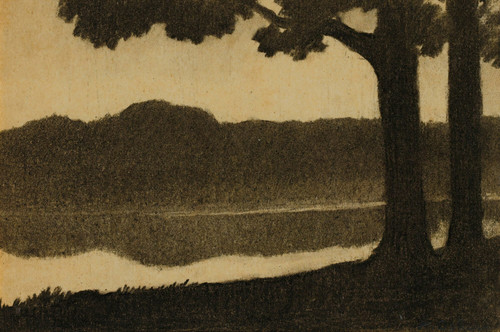
As we place "In The Evening's Tranquility" within its art historical context, it becomes evident that Alphonse Osbert's work occupies a pivotal position in the late 19th-century landscape tradition. Created in 1897, this painting embodies the expressive freedom of Modernism while still adhering to the rigorous technical standards of its predecessors. The artist's deliberate use of impasto, where thick layers of paint are applied to achieve a textured effect, imbues the work with a sculptural quality that rewards close examination.
The dark blues and greens that dominate the palette establish an atmosphere of contemplative calm, while muted yellows and white highlights serve to underscore the drama of contrasts inherent in Osbert's design. The minimalist composition, characterized by a deliberate avoidance of extraneous details, serves to focus the viewer's attention on the tranquil, natural world unfolding before them.
As we consider the spatial behavior of "In The Evening's Tranquility" at its intended scale of 66x44, it becomes clear that the chromatic structure of the painting exerts a profound influence on the surrounding environment. The rich, dark tones assume an almost three-dimensional quality, as if drawn from the very fabric of the walls themselves. In a luxury interior setting, this work would pair well with materials such as rough-hewn limestone or weathered wood, their textures and undertones perfectly complementing the painting's atmospheric weight.
The spatial rhythm established by Osbert's composition – where deep shadows recede into an unfathomable distance, only to be punctuated by bursts of luminous highlight – creates a sense of depth that seems almost infinite. As such, it is essential to balance this effect with judicious placement and lighting strategies. In a well-designed space, the painting would serve as a focal point for both visual and atmospheric exploration, guiding the viewer's eye through an experiential journey from the intimate recesses of the surrounding architecture into the limitless expanse beyond.
In a room where light pours in abundance – such as a soaring atrium or a gallery with clerestory windows – "In The Evening's Tranquility" would assume a role akin to that of a spatial anchor, its dark tones absorbing and redirecting ambient illumination while its highlights seem to radiate outward like beacons. Conversely, where light is scarce – in a more somber, introverted space – the painting would amplify and reflect any available luminescence, casting an aura of calm over the surrounding environment.
Through its deliberate manipulation of spatial depth, chromatic structure, and atmospheric weight, "In The Evening's Tranquility" offers interior designers a unique opportunity to engage with the material properties of their chosen architectural space. By carefully pairing this work with complementary materials and lighting strategies, they may create an immersive experience that draws the viewer into the very heart of the natural world – one where the boundaries between art, architecture, and environment dissolve in favor of a harmonious, transcendent whole.
This edition's spatial clarity and controlled palette align naturally with modernist interiors.
Architectural Behavior
Its horizontal span reinforces axial movement across long architectural planes.
This edition functions as a 66x44 interior anchor, shaping spatial rhythm and establishing a stable visual cadence within the surrounding architecture.
Its chromatic structure responds to natural and artificial lighting, modulating depth and atmospheric weight throughout the day.
Recommended material pairings include natural oak, brushed metal, matte stone composites, and textured linen surfaces.
Gallery Edition Specifications
- Format: 66" x 44" Interior Architectural Study
- Medium: 330gsm Ultra-Premium Fine Art Matte
- Ink System: Wide-gamut archival pigment curation
- Mounting: Delivered unframed for professional gallery installation
Each edition is prepared to order. Gallery-standard quality control requires 3 to 5 business days.