
Curatorial Narrative
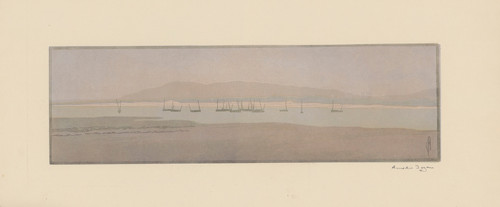
In the context of early 20th-century Impressionism, Amédée Joyau's Entrée de la Canche (Étaples, Pas-de-Calais) occupies a distinct position within the genre, one that reflects the artist's fascination with capturing the fleeting effects of natural light on landscape. Executed in 1900, this work demonstrates Joyau's innovative approach to brushwork, characterized by soft, feathery strokes that imbue the composition with an air of spontaneity and immediacy.
As the eye navigates the painting's minimalist structure, it becomes apparent that Joyau has employed a deliberate restraint in his use of color, favoring muted blues, grays, and browns to evoke the somber tones of the northern French coastline. The soft pinkish hue in the foreground serves as a subtle counterpoint to this dominant palette, introducing a hint of warmth and depth to an otherwise coolly rendered scene.
A reproduction of Entrée de la Canche (Étaples, Pas-de-Calais) at 106x44 inches would reveal a complex interplay between spatial rhythm and chromatic structure. The muted color palette would still maintain its atmospheric weight, but the enlargement would allow for a more nuanced exploration of the artist's brushwork, highlighting the intricate textures that give the painting its visual interest. In a luxury interior environment, this artwork would complement a range of materials, from weathered stone to richly textured woods, and would interact with lighting in ways both subtle and dramatic.
As the spatial depth of the composition is magnified, the viewer's perception of the scene is altered, with the landscape unfolding across a larger scale. The minimalist design structure remains intact, but its influence on the surrounding space becomes more pronounced, as if the painting is exerting a calming presence over the adjacent architecture. In terms of material pairing, Entrée de la Canche (Étaples, Pas-de-Calais) would pair well with warm, earthy tones and organic materials, such as reclaimed wood or woven fibers, to create a sense of cohesion between artwork and environment.
In an interior space, the soft pinkish hue in the foreground of the painting would likely serve as a visual anchor, drawing the viewer's eye through the composition and into the surrounding architecture. As lighting is adjusted to highlight different aspects of the scene, the interplay between color and light would become even more pronounced, with the muted blues and grays deepening in tone while the pinkish hue remains a vibrant counterpoint.
A carefully considered placement of Entrée de la Canche (Étaples, Pas-de-Calais) within a luxury interior would require attention to both spatial rhythm and atmospheric weight. As a large-scale reproduction, the painting's minimalist structure would impose itself on the surrounding space, creating a sense of calm and serenity that is both subtle and profound.
This edition's spatial clarity and controlled palette align naturally with modernist interiors.
Architectural Behavior
Its horizontal span reinforces axial movement across long architectural planes.
This edition functions as a 106x44 interior anchor, shaping spatial rhythm and establishing a stable visual cadence within the surrounding architecture.
Its chromatic structure responds to natural and artificial lighting, modulating depth and atmospheric weight throughout the day.
Recommended material pairings include natural oak, brushed metal, matte stone composites, and textured linen surfaces.
Gallery Edition Specifications
- Format: 106" x 44" Interior Architectural Study
- Medium: 330gsm Ultra-Premium Fine Art Matte
- Ink System: Wide-gamut archival pigment curation
- Mounting: Delivered unframed for professional gallery installation
Each edition is prepared to order. Gallery-standard quality control requires 3 to 5 business days.


