Curatorial Narrative
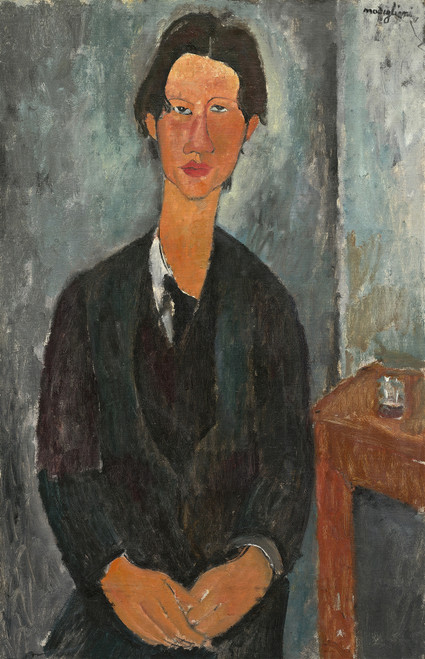
In 1917, Amedeo Modigliani's Café Singer represents the artist's attempt to reconcile his figurative inclinations with the emerging Modernist currents of the time. Characterized by a deliberate use of impasto and bold brushstrokes, the work displays a tension between two-dimensional representation and three-dimensional spatial presence, foreshadowing the sculptural tendencies of subsequent avant-garde movements.
The artist's palette in Café Singer is notable for its deployment of dark, rich tones – black, gray, green, brown, and beige – which contribute to an overall sense of atmospheric weight. This chromatic structure imbues the work with a sense of gravitas, underscoring the subject's introspective nature. When enlarged to 44x68 inches, these colors become even more pronounced, their spatial depth and visual resonance augmented by the intricate interplay between impasto texture and background plane.
In this larger format, Café Singer assumes an imposing presence, its Art Deco-inspired design elements imbuing the work with a sense of modernist abstraction. The subject's elongated form appears to recede into the background, creating a sense of spatial rhythm that is at once dynamic and contemplative. As such, it becomes clear that this painting would be most effectively realized in a luxurious interior environment characterized by sleek, high-gloss materials – polished marble or mirrored surfaces – which would reflect and amplify the work's chromatic structure.
The subtle interplay between light and material is critical to the overall impact of Café Singer at this scale. As natural light falls upon the painting, its dark tones appear to absorb and radiate energy, imbuing the surrounding space with a sense of depth and atmospheric presence. In contrast, artificial lighting – such as floor lamps or sconces – would accentuate the work's textural qualities, drawing attention to the intricate network of brushstrokes and impasto ridges that comprise its surface.
Ultimately, Café Singer's presence in a luxury interior environment would be characterized by a sense of refinement and restraint, its Art Deco-inspired design elements serving as a subtle nod to the period's penchant for modernist abstraction. The work's spatial rhythm and chromatic structure would contribute to a sense of calm, contemplative atmosphere, one that is at once sophisticated and understated – an ideal accompaniment to high-end materials and sleek, modernist furnishings.
This edition's spatial clarity and controlled palette align naturally with modernist interiors.
Architectural Behavior
Its vertical rise introduces a stabilizing architectural counterpoint.
This edition functions as a 44x68 interior anchor, shaping spatial rhythm and establishing a stable visual cadence within the surrounding architecture.
Its chromatic structure responds to natural and artificial lighting, modulating depth and atmospheric weight throughout the day.
Recommended material pairings include natural oak, brushed metal, matte stone composites, and textured linen surfaces.
Gallery Edition Specifications
- Format: 44" x 68" Interior Architectural Study
- Medium: 330gsm Ultra-Premium Fine Art Matte
- Ink System: Wide-gamut archival pigment curation
- Mounting: Delivered unframed for professional gallery installation
Each edition is prepared to order. Gallery-standard quality control requires 3 to 5 business days.