Curatorial Narrative
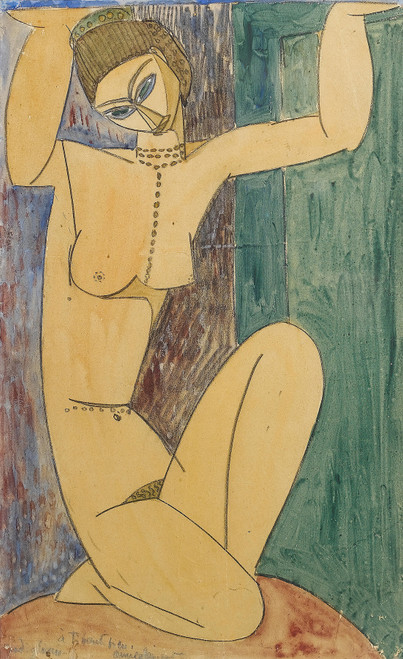
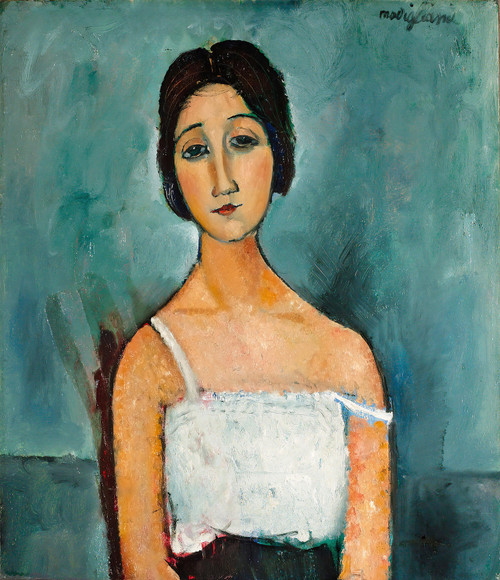
The "Nudo seduto" series, created by Amedeo Modigliani in 1913-1914, represents a pivotal moment in the artist's oeuvre, where his figurative style begins to intersect with modernist ideals. Characterized by soft brushwork and an emphasis on atmospheric weight, these nudes embody a quiet introspection, as if the subject is suspended in a state of meditation. The palette, dominated by blues and beige hues, imbues the painting with a sense of melancholic serenity, underscoring the artist's fascination with the human form and its emotional resonance.
When scaled to 44x64 inches, "Nudo seduto" assumes a commanding presence within a luxury interior environment, its chromatic structure unfolding like a spatial rhythm. The blues, deep and rich as they are, exert a calming influence on the surroundings, while the beige undertones subtly tie in with the ambient lighting. In conjunction with a carefully calibrated palette of materials – say, a limestone floor or a silk-upholstered sofa – the painting's atmospheric weight will harmonize with the space, creating an atmosphere redolent with contemplative quietude. Furthermore, the minimalist design style inherent to Modigliani's approach allows for flexibility in terms of material pairing and lighting behavior, ensuring that the painting remains an integral part of the architectural narrative rather than a mere decorative element.
The spatial depth achieved through Modigliani's use of sfumato creates a sense of visual tension, drawing the viewer into the subject's introspective world. This, combined with the artist's tendency to flatten and abstract the figure, imbues the painting with a degree of ambiguity that rewards close observation. Within a luxury interior setting, "Nudo seduto" will assume its own spatial identity, its atmospheric weight interacting with the surrounding space in a delicate dance of light and material.
In terms of architectural influence, Modigliani's use of negative space underscores the importance of restraint and simplicity in high-end design. By stripping away extraneous details, the artist reveals the underlying structure of his subject, much like an architect might reveal the hidden geometry of a building through deliberate placement of voids and solids. This approach to composition serves as a powerful reminder that even within the most opulent of interiors, subtlety and restraint can be just as effective in creating a lasting impression as bold statement pieces.
When considering "Nudo seduto" for a specific interior context, it is essential to consider not only its visual properties but also its atmospheric and spatial implications. The painting's blues, which might initially seem somber or melancholic, will actually contribute to the overall ambiance of the space by introducing a calming influence on the surrounding environment. In conjunction with carefully selected materials – say, a luxurious fabric or a richly textured wallcovering – "Nudo seduto" will create an atmosphere redolent with contemplative quietude, inviting the viewer to slow their pace and engage more deeply with their surroundings.
The interplay between Modigliani's composition and the surrounding space will be influenced by the painting's minimalist design style, which allows it to adapt seamlessly to a variety of interior contexts. Whether paired with a sleek, modern sofa or a richly patterned rug, "Nudo seduto" will remain an integral part of the architectural narrative, its atmospheric weight interacting with the space in a delicate dance of light and material.
Ultimately, when incorporating "Nudo seduto" into a luxury interior environment, it is essential to prioritize a thoughtful consideration of spatial relationships, material pairing, and lighting behavior. By doing so, one can unlock the full potential of this remarkable painting, allowing its atmospheric weight to imbue the space with
This edition's spatial clarity and controlled palette align naturally with modernist interiors.
Architectural Behavior
Its vertical rise introduces a stabilizing architectural counterpoint.
This edition functions as a 44x64 interior anchor, shaping spatial rhythm and establishing a stable visual cadence within the surrounding architecture.
Its chromatic structure responds to natural and artificial lighting, modulating depth and atmospheric weight throughout the day.
Recommended material pairings include natural oak, brushed metal, matte stone composites, and textured linen surfaces.
Gallery Edition Specifications
- Format: 44" x 64" Interior Architectural Study
- Medium: 330gsm Ultra-Premium Fine Art Matte
- Ink System: Wide-gamut archival pigment curation
- Mounting: Delivered unframed for professional gallery installation
Each edition is prepared to order. Gallery-standard quality control requires 3 to 5 business days.