Curatorial Narrative
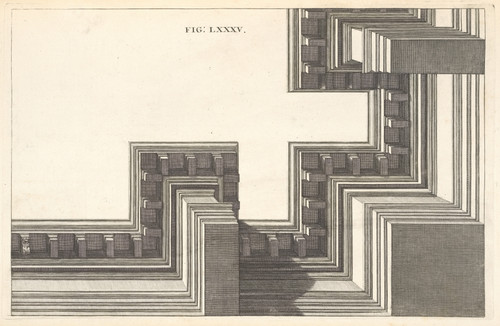
Andrea Pozzo's "The optick projection of a Corinthian cornice, with the capital and part of the column" (1707) is a masterful exemplar of Neoclassical technique, its linear brushwork conjuring an almost palpable sense of architectural presence. This work's historical position lies at the confluence of Renaissance Revival and Classical influences, Pozzo's skillful deployment of chiaroscuro imbuing the composition with a profound atmospheric weight that draws the viewer's eye inexorably into the spatial rhythm of the scene.
When scaled to 65x44, Pozzo's "Optick projection" reveals itself as a carefully crafted exercise in chromatic structure, its black and white palette imbuing the space with an unyielding sense of materiality. The reduction of atmospheric depth to a mere suggestion allows for a heightened emphasis on spatial relationships, the capital and column emerging from the void like monolithic sentinels, their presence anchored by Pozzo's masterful control over light and shadow.
The optick projection of a Corinthian cornice, with the capital and part of the column
In a luxury interior setting, Pozzo's work would prove an inspired choice for a grand hallway or foyer, its sheer scale commanding attention while subtly underscoring the surrounding architecture. The stark contrast between black and white would provide a striking backdrop for the judicious deployment of rich, dark materials such as polished walnut or ebony, their warmth offset by the icy precision of Pozzo's lines. As ambient light falls upon the composition, it would pick out the subtle nuances of texture and surface, imbuing the space with an aura of weighty gravitas that is at once imposing and refined.
Pozzo's "Optick projection" would also serve as a compelling foil to the surrounding spatial rhythm, its deliberate pacing and measured proportions subtly subverting expectations even as it reinforces the notion of architectural grandeur. By carefully selecting materials that complement Pozzo's stark palette – perhaps sumptuous silks or subtle marble veining – interior designers could create an environment at once stately and refined, one in which the viewer is drawn inexorably into the visual vortex of the composition.
In its unyielding commitment to the ideals of Classical form, "The optick projection" offers a compelling model for luxury interior design, its measured proportions and deliberate pacing serving as a powerful antidote to the prevailing emphasis on ornate decoration. By embracing Pozzo's austere beauty, designers can create environments that are at once imposing and refined, their inhabitants drawn into a world of dignified repose.
Pozzo's "Optick projection" would also serve as an effective counterpoint to more opulent elements in the surrounding space – perhaps a gilded chandelier or lavish tapestry – its strictures serving as a reminder that true luxury is not merely about excess, but rather about the judicious deployment of form and material. By pairing Pozzo's work with carefully chosen materials and spatial arrangements, designers can create environments that are at once majestic and restrained, their inhabitants inhabiting a world of dignified repose.
When enlarged to 65x44, "The optick projection" reveals itself as a masterful exercise in spatial relationships, its measured proportions and deliberate pacing serving as a powerful counterpoint to the surrounding environment. The stark contrast between black and white would provide a striking backdrop for the judicious deployment of rich materials such as polished walnut or sumptuous silks, their warmth offset by Pozzo's icy precision.
Pozzo's "Optick projection" is a work that resists easy categorization, its austere beauty existing in a delicate tension between Classical form and Renaissance Revival influences. When
This edition adapts fluidly across contemporary interior profiles, offering a stable architectural anchor.
Architectural Behavior
Its vertical rise introduces a stabilizing architectural counterpoint.
This edition functions as a 65x44 interior anchor, shaping spatial rhythm and establishing a stable visual cadence within the surrounding architecture.
Its chromatic structure responds to natural and artificial lighting, modulating depth and atmospheric weight throughout the day.
Recommended material pairings include natural oak, brushed metal, matte stone composites, and textured linen surfaces.
Gallery Edition Specifications
- Format: 65" x 44" Interior Architectural Study
- Medium: 330gsm Ultra-Premium Fine Art Matte
- Ink System: Wide-gamut archival pigment curation
- Mounting: Delivered unframed for professional gallery installation
Each edition is prepared to order. Gallery-standard quality control requires 3 to 5 business days.