Curatorial Narrative
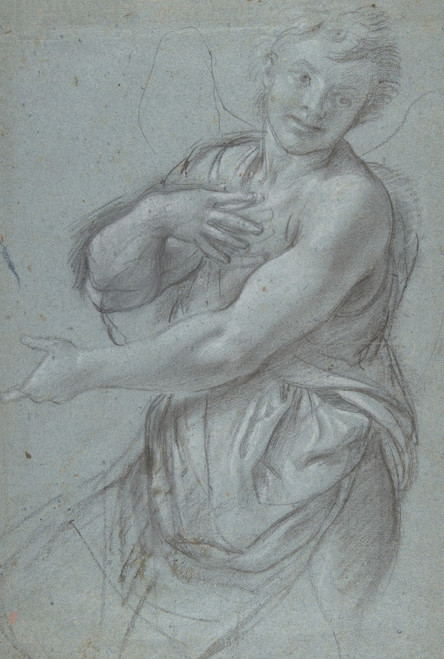
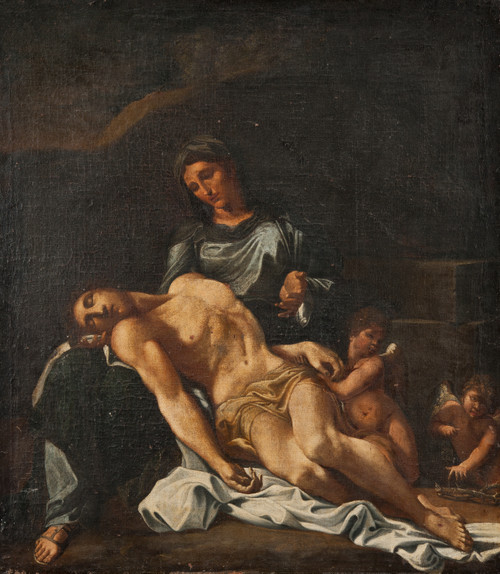
In the year 1606, Annibale Carracci's "Madonna with the Bowl" solidified his position within the burgeoning Baroque movement, which sought to revitalize classical ideals through an infusion of emotional intensity and expressive brushwork. The linear technique employed by Carracci in this work serves as a deliberate contrast to the rich textures and dramatic lighting that would come to define the style, instead opting for a more contained, almost austere quality.
The visual syntax of "Madonna with the Bowl" is characterized by a strict adherence to Renaissance design principles, yet its very structure betrays a nascent tension. Upon enlargement to 57x44, the chromatic structure appears as a deliberate exercise in contrast and gradation, where black outlines define the figures against an expanse of white that imbues the space with an almost palpable atmospheric weight. The spatial rhythm established by Carracci's composition becomes a study in subtle juxtapositions: the flatness of the background plane is subtly disrupted by the rounded contours of the Madonna, while her gesture towards the bowl serves as a poignant reminder of the human presence within this otherwise starkly defined environment.
The impact of "Madonna with the Bowl" when scaled to a large format becomes one of deliberate restraint, where the artist's choices regarding palette and composition serve to underscore the materiality of the space itself. When placed within a luxury interior setting, the black outlines that define the figures appear as a striking counterpoint to richly textured wall coverings or sumptuous upholstery, while the white expanse serves as a neutral backdrop for a variety of lighting treatments. The subtle gradations of value and texture established by Carracci's linear technique become a valuable tool in balancing competing spatial elements, imbuing the space with an air of understated elegance that is at once both restrained and profoundly expressive.
The very scale of "Madonna with the Bowl" becomes a testament to the artist's skill as a master of visual mechanics, where his choices regarding composition and palette serve to underscore the unique properties of the format itself. As such, the artwork assumes a life beyond its original purpose as a devotional icon, instead becoming an active participant in the spatial dynamics of the interior environment.
This edition adapts fluidly across contemporary interior profiles, offering a stable architectural anchor.
Architectural Behavior
Its horizontal span reinforces axial movement across long architectural planes.
This edition functions as a 57x44 interior anchor, shaping spatial rhythm and establishing a stable visual cadence within the surrounding architecture.
Its chromatic structure responds to natural and artificial lighting, modulating depth and atmospheric weight throughout the day.
Recommended material pairings include natural oak, brushed metal, matte stone composites, and textured linen surfaces.
Gallery Edition Specifications
- Format: 57" x 44" Interior Architectural Study
- Medium: 330gsm Ultra-Premium Fine Art Matte
- Ink System: Wide-gamut archival pigment curation
- Mounting: Delivered unframed for professional gallery installation
Each edition is prepared to order. Gallery-standard quality control requires 3 to 5 business days.