Curatorial Narrative
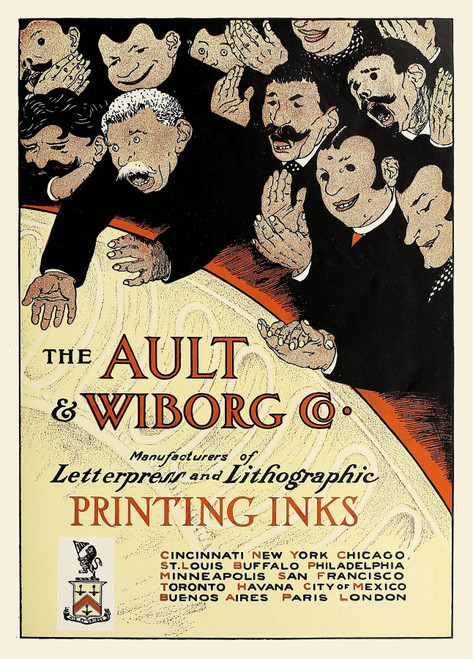
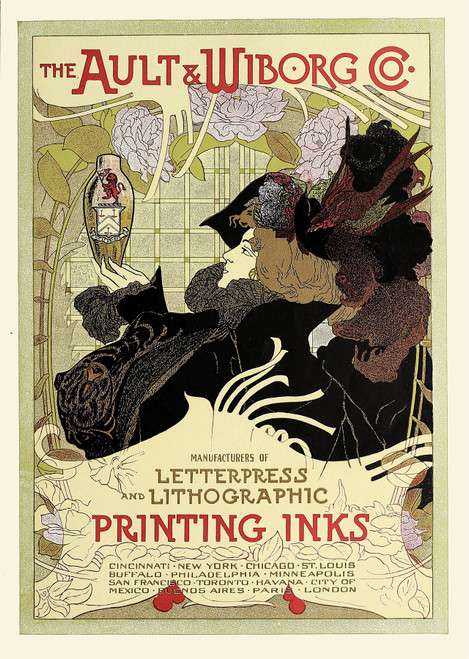
The anonymous artist's "Ault and Wiborg, Ad. 031" embodies the Art Nouveau movement's fascination with sinuous lines and organic forms. Executed between 1890 and 1913, this work is a testament to the era's obsession with architectural decoration. The linear brushwork, reminiscent of the Japanese woodblock prints that influenced European art at the time, imbues the composition with a sense of dynamism, as if the structure itself were in motion.
As "Ault and Wiborg, Ad. 031" is enlarged to 44x61 inches, its palette reveals a deliberate balance between bold chromatic accents – the vibrant yellow and deep red – and the muted background tones, which evoke a sense of atmospheric weight. The spatial depth created by the artist's use of layered planes and recessed areas contributes to an intriguing tension between materiality and illusion. In a luxury interior environment, this print would pair well with metallic surfaces and rich textiles, as its linear structure would create a dialogue with geometric patterns and reflective finishes. As lighting falls upon "Ault and Wiborg, Ad. 031," its design styles – hints of Art Deco and Modernist influences – would be thrown into relief, influencing the spatial rhythm of the surrounding space.
The artist's deployment of contrasting planes and layered forms creates a sense of spatial complexity that is both captivating and challenging. Upon enlargement, "Ault and Wiborg, Ad. 031" reveals itself to be a masterful exercise in atmospheric depth, where the visual field is divided into distinct zones of tension and repose. In an interior setting, this work would engage with its surroundings through strategic material pairings – perhaps a combination of glass, metal, or leather – that amplify the interplay between light and shadow.
In the context of luxury interior design, "Ault and Wiborg, Ad. 031" assumes a role that is both decorative and structural. Its Art Nouveau style, with its characteristic emphasis on sinuous lines and organic forms, would contribute to an environment characterized by fluidity and movement. As the print interacts with surrounding architectural elements – columns, archways, or other design features – its linear structure creates a dynamic dialogue between materiality and space.
The anonymous artist's use of blue and green hues adds a sense of visual nuance to "Ault and Wiborg, Ad. 031," introducing a range of atmospheric possibilities that would impact the interior environment in subtle yet meaningful ways. As the light falls upon this work, its various design styles – Art Deco, Modernist – emerge as strategic choices, rather than mere stylistic flourishes. In a room where the artist's print is prominently displayed, the spatial rhythm would be influenced by the contrast between its linear structure and the surrounding architectural features.
As "Ault and Wiborg, Ad. 031" interacts with its surroundings, its material presence becomes an integral aspect of the interior environment. The interplay between light and shadow creates a range of effects – highlights and lowlights, areas of tension and repose – that engage the viewer on multiple levels. In this work, we find a unique balance between decorative intent and spatial awareness, where the artist's use of color and form serves to create an atmosphere that is both immersive and thought-provoking.
The anonymous artist's "Ault and Wiborg, Ad. 031" represents a high point in the Art Nouveau movement's exploration of architectural decoration. Executed during a period of significant artistic innovation, this work embodies the era's fascination with sinuous lines, organic forms, and atmospheric depth. As we examine its visual mechanics – style,
This edition's spatial clarity and controlled palette align naturally with modernist interiors.
Architectural Behavior
Its vertical rise introduces a stabilizing architectural counterpoint.
This edition functions as a 44x61 interior anchor, shaping spatial rhythm and establishing a stable visual cadence within the surrounding architecture.
Its chromatic structure responds to natural and artificial lighting, modulating depth and atmospheric weight throughout the day.
Recommended material pairings include natural oak, brushed metal, matte stone composites, and textured linen surfaces.
Gallery Edition Specifications
- Format: 44" x 61" Interior Architectural Study
- Medium: 330gsm Ultra-Premium Fine Art Matte
- Ink System: Wide-gamut archival pigment curation
- Mounting: Delivered unframed for professional gallery installation
Each edition is prepared to order. Gallery-standard quality control requires 3 to 5 business days.