Curatorial Narrative
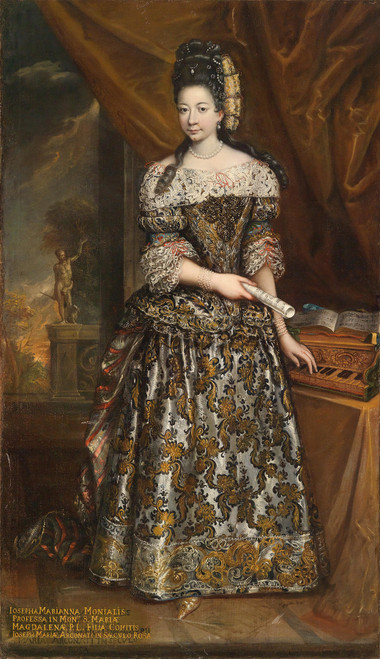
The anonymous artist's "Costumes Parisiens, no. 8" occupies a pivotal position within the Art Nouveau movement of the early 20th century. Painted in 1912, this work embodies the style's characteristic sinuous lines and organic forms, here applied to a delicate depiction of a woman resplendent in an intricately patterned gown. The brushwork is refined, with a focus on capturing the subtle nuances of light and texture that infuse the scene with a sense of atmospheric weight.
As one considers "Costumes Parisiens" at a scale equivalent to 44x76 inches, the neutral tones and pops of red from the roses assume a more pronounced role in establishing a chromatic structure. The spatial depth created by the layered folds of the subject's garment and the subtle atmospheric perspective employed in the background contribute to a sense of visual tension. In this context, the Art Nouveau style's emphasis on flowing lines and curvilinear forms yields a composition that seems to undulate like the gentle swell of fabric. When paired with suitable materials, such as rich woods or opulent textiles, the artwork assumes an almost sculptural quality, its atmospheric weight drawing the viewer into the spatial rhythm created by the piece.
When enlarged, the design's Victorian influences emerge more explicitly, particularly in the ornate patterns and motifs that adorn the subject's attire. The Art Nouveau style's characteristic sense of fluidity is tempered here by a more rigid, almost Gothic, sense of structure. The result is a composition that exudes an air of refined luxury, its elaborate details suggesting the opulence of a bygone era. In a high-end interior environment, this artwork would serve as a striking focal point, its intricate patterns and sinuous lines drawing the eye towards a central axis while creating a sense of spatial cohesion.
In terms of material pairing, "Costumes Parisiens" would be ideally suited to environments featuring rich, dark woods such as ebony or mahogany, which would amplify the artwork's atmospheric weight. The pops of red from the roses would also serve to enhance the presence of any adjacent metallic accents, creating a sense of visual resonance that draws the viewer's eye through the space. When illuminated, the artwork's fine brushwork and delicate color palette assume a softer, more muted quality, while the spatial depth created by the layered folds of the subject's garment yields a sense of volume and three-dimensionality.
When placed within an interior environment, "Costumes Parisiens" assumes a role that is at once both static and dynamic. Its intricate patterns and sinuous lines seem to shift and move as one navigates the space, creating a sense of visual tension that draws the viewer's eye towards key axes and focal points. The artwork's atmospheric weight also serves to create a sense of spatial cohesion, its chromatic structure drawing disparate elements within the room together into a unified whole.
The anonymous artist's "Costumes Parisiens" is a masterful exercise in style and technique, one that not only exemplifies the aesthetic ideals of Art Nouveau but also offers a nuanced exploration of the relationship between color, form, and spatial depth. As a designed object, this work assumes a unique status within the realm of fine art, its very presence seeming to alter the spatial rhythm of the environment in which it is placed.
When viewed from a distance, "Costumes Parisiens" presents a serene, almost tranquil, image, one that belies the intricate patterns and sinuous lines that come into sharper focus as one draws closer. The delicate color palette and fine brushwork contribute to a sense of atmospheric weight, while the spatial depth created by the layered folds of the subject's garment yields a sense
This edition adapts fluidly across contemporary interior profiles, offering a stable architectural anchor.
Architectural Behavior
Its vertical rise introduces a stabilizing architectural counterpoint.
This edition functions as a 44x76 interior anchor, shaping spatial rhythm and establishing a stable visual cadence within the surrounding architecture.
Its chromatic structure responds to natural and artificial lighting, modulating depth and atmospheric weight throughout the day.
Recommended material pairings include natural oak, brushed metal, matte stone composites, and textured linen surfaces.
Gallery Edition Specifications
- Format: 44" x 76" Interior Architectural Study
- Medium: 330gsm Ultra-Premium Fine Art Matte
- Ink System: Wide-gamut archival pigment curation
- Mounting: Delivered unframed for professional gallery installation
Each edition is prepared to order. Gallery-standard quality control requires 3 to 5 business days.