Curatorial Narrative
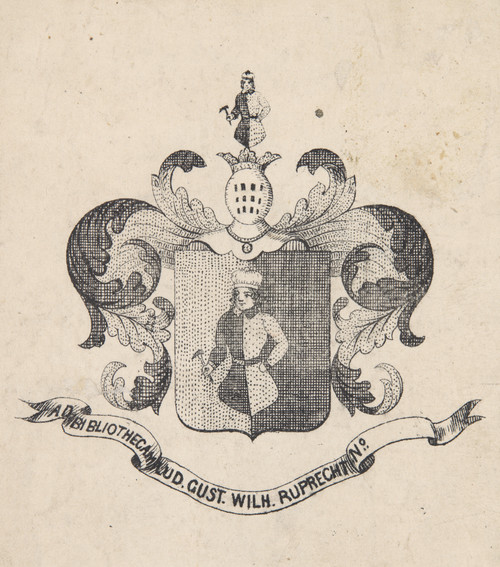
The "Ekslibris Francisci Roux et Amicorum" exemplifies the lingering presence of Renaissance Revival and Baroque influences in the visual language of 1875. The anonymous artist's masterful deployment of linear brushwork, characteristic of the period, imbues the work with a sense of formal restraint, which in turn underscores the importance of architectural subject matter. The chosen palette, confined to black and white, lends an air of gravitas to the composition, as if the very absence of color serves to emphasize the structural integrity of the depicted edifice.
When enlarged to 44x49 inches, the spatial rhythm established by the artist's use of line and form begins to exert a profound influence on the surrounding environment. The stark black and white chromatic structure creates an atmosphere of controlled intensity, as if the very walls themselves were drawn into a dialogue with the architectural subject. In a luxury interior setting, this edition would pair particularly well with materials such as polished limestone or matte-black steel, their tactile presence subtly amplified by the graphic weight of the artwork. As light is cast upon the surface, the subtle nuances of line and form begin to emerge, generating an almost palpable sense of spatial depth that draws the viewer inexorably into the depicted structure.
The "Ekslibris Francisci Roux et Amicorum" would likely be displayed against a wall with a subtle texture, perhaps a matte-finish plaster or a richly grained wood panel. This treatment would allow the work to engage with its surroundings through a carefully calibrated interplay of materiality and luminosity.
The spatial impact of this edition is one of measured grandeur, as if the very presence of the artwork were subtly recalibrating the proportions of the room itself. In a well-appointed luxury interior, this effect could be skillfully exploited to create a sense of continuity between the architectural subject and its surroundings, blurring the boundaries between art and environment in a manner both elegant and restrained.
The artist's use of line and form serves to establish a clear spatial hierarchy within the composition, with the central arch serving as a visual axis around which the surrounding elements are arranged. This formal clarity lends itself particularly well to a space with clean lines and minimal ornamentation, where the graphic weight of the artwork can be allowed to take center stage.
In terms of lighting, the "Ekslibris Francisci Roux et Amicorum" would benefit from a thoughtful approach that balances the needs of both the artwork and its surroundings. A soft, diffused light source would help to minimize glare while allowing the subtle nuances of line and form to emerge, thereby creating an atmosphere of quiet contemplation.
Ultimately, it is in the nuanced interplay between materiality, luminosity, and spatial structure that the true significance of this edition lies, as if the very presence of the artwork were subtly recalibrating the proportions of the room itself.
This edition adapts fluidly across contemporary interior profiles, offering a stable architectural anchor.
Architectural Behavior
Its vertical rise introduces a stabilizing architectural counterpoint.
This edition functions as a 44x49 interior anchor, shaping spatial rhythm and establishing a stable visual cadence within the surrounding architecture.
Its chromatic structure responds to natural and artificial lighting, modulating depth and atmospheric weight throughout the day.
Recommended material pairings include natural oak, brushed metal, matte stone composites, and textured linen surfaces.
Gallery Edition Specifications
- Format: 44" x 49" Interior Architectural Study
- Medium: 330gsm Ultra-Premium Fine Art Matte
- Ink System: Wide-gamut archival pigment curation
- Mounting: Delivered unframed for professional gallery installation
Each edition is prepared to order. Gallery-standard quality control requires 3 to 5 business days.