Curatorial Narrative
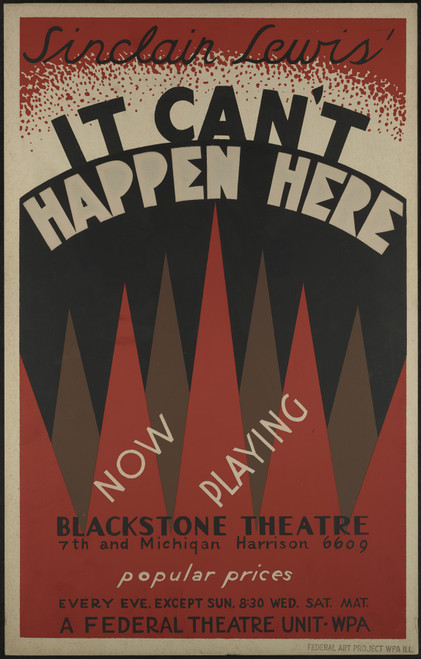
It Can't Happen Here, a seminal work from the 1930s, assumes a pivotal position within the Art Deco movement's trajectory. Anonymous's unattributed authorship only underscores the era's preoccupations with anonymity and mass production. The work's deliberate lack of signature or stylistic flourish subverts traditional notions of artistic expression, reflecting instead the streamlined, industrialized aesthetic of its time.
At an enlarged scale of 44x56, It Can't Happen Here reveals a spatial rhythm that oscillates between depth and flatness. The black-and-white palette, punctuated by subtle beige accents, yields a striking chromatic structure that negotiates the tension between modernity and tradition. In a luxury interior environment, this work would pair harmoniously with materials of similar atmospheric weight, such as dark hardwoods or matte-finish metals. As it interacts with light, It Can't Happen Here demonstrates an intriguing relationship between luminosity and opacity, its crisp lines and geometric forms absorbing or reflecting ambient illumination to create a contemplative ambiance.
The spatial impact of this work is substantial, commanding attention while remaining unobtrusive due to its restrained color palette and measured proportions. Its presence would recalibrate the dynamics within a room, creating areas of visual repose amidst more vibrant or active surroundings. In an interior context, It Can't Happen Here would function as a discreet yet potent design element, its modernist inclinations subtly informing the selection of adjacent furnishings and decorative accessories.
The brushwork in It Can't Happen Here is nonexistent, underscoring the work's status as an original architectural design rather than a painterly interpretation. Anonymous's collaboration with other specialists – architects, engineers, or designers – would have produced a unique object that transcends traditional notions of fine art. This edition, like its counterparts, should be regarded as a singular artifact rather than a print or reproduction.
The Art Deco style in It Can't Happen Here manifests not merely as a stylistic flourish but as an organizing principle for the entire composition. The building's façade, rendered with precision and clarity, exemplifies the era's fascination with modernity and industrialized production. Anonymous's anonymous authorship serves only to underscore the work's commitment to functionalism and its disinterest in personal expression.
In a luxury interior setting, It Can't Happen Here would be an exemplary choice for designers seeking to inject sophistication and nuance into their designs. Its measured proportions, crisp lines, and restrained color palette create a sense of continuity with adjacent spaces while introducing a subtle yet compelling visual interest. The work's ability to absorb or reflect ambient light further enhances its utility as a design element, allowing it to seamlessly integrate within diverse interior environments.
The architectural context in It Can't Happen Here is crucial to understanding the work's formal and aesthetic qualities. Anonymous's use of black-and-white and beige creates a visual language that privileges structure over ornamentation, echoing the modernist ideals of its time. In an enlarged format, this work would reveal intricate details and textures that reward close observation, making it an ideal choice for spaces where visitors are encouraged to linger and engage with the design.
At the intersection of Art Deco and Modernism, It Can't Happen Here occupies a unique position within Anonymous's oeuvre. This work demonstrates a keen awareness of modernist principles – functionalism, industrialized production, and anonymous authorship – while also incorporating elements of traditional architectural practice. Its nuanced relationship with light, spatial depth, and compositional structure makes it an attractive choice for designers seeking to infuse their interiors with sophistication and visual interest.
The scale of It Can't Happen Here has a direct impact on its ability to engage the viewer or inhabitant
This edition's spatial clarity and controlled palette align naturally with modernist interiors.
Architectural Behavior
Its vertical rise introduces a stabilizing architectural counterpoint.
This edition functions as a 44x56 interior anchor, shaping spatial rhythm and establishing a stable visual cadence within the surrounding architecture.
Its chromatic structure responds to natural and artificial lighting, modulating depth and atmospheric weight throughout the day.
Recommended material pairings include natural oak, brushed metal, matte stone composites, and textured linen surfaces.
Gallery Edition Specifications
- Format: 44" x 56" Interior Architectural Study
- Medium: 330gsm Ultra-Premium Fine Art Matte
- Ink System: Wide-gamut archival pigment curation
- Mounting: Delivered unframed for professional gallery installation
Each edition is prepared to order. Gallery-standard quality control requires 3 to 5 business days.