Curatorial Narrative
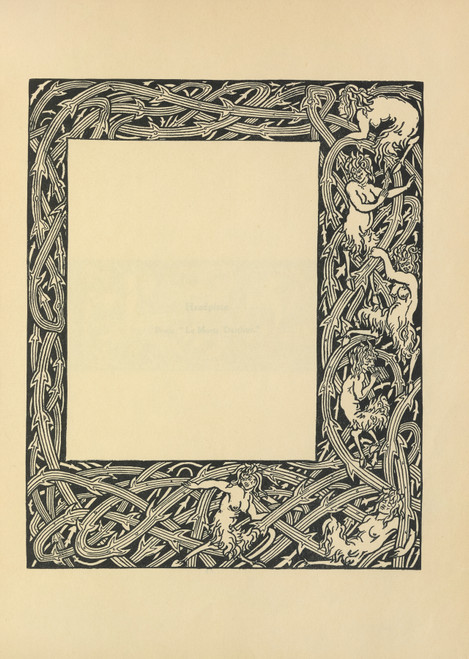
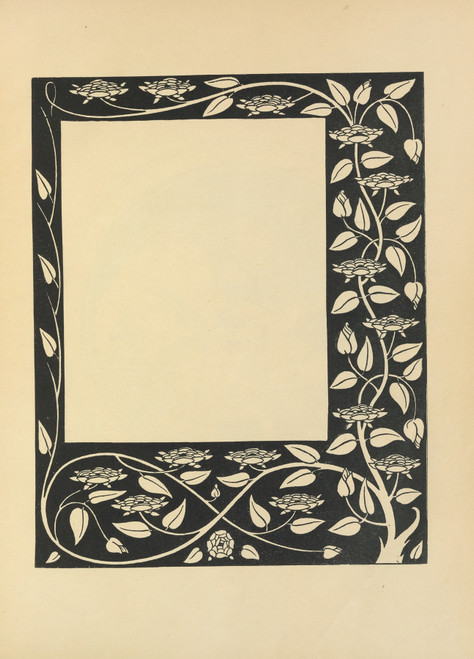
In 1893, Aubrey Beardsley's "Praying Angels and Poppies" marked a pivotal moment in the evolution of Art Nouveau. This border design for Thomas Malory's "Le Morte d'Arthur" showcases Beardsley's unique fusion of Japanese influence with Western aesthetics. The linear brushwork and stark black-and-white palette evoke a sense of atmospheric weight, drawing the viewer into the intricate details of the composition. By exploiting the expressive potential of linearity, Beardsley creates a spatial rhythm that is both dynamic and contemplative.
When enlarged to 44x56 inches, "Praying Angels and Poppies" assumes a commanding presence in a luxury interior environment. The black poppies against a white ground create a striking chromatic structure that can be expertly balanced by the judicious selection of materials. For instance, a rich charcoal-gray stone or a gleaming lacquer finish could harmonize with the design's dark tones, while a lighter wood or a delicate glass surface would enhance its airy qualities. The spatial depth achieved through Beardsley's use of overlapping lines and layered motifs lends itself to thoughtful lighting placement: strategically positioned spotlights can draw attention to key areas of the composition, while ambient illumination reveals the intricate texture of the paper.
The atmospheric weight of "Praying Angels and Poppies" is influenced by its relationship with the surrounding space. In a large-scale installation, the design's angular lines and fluid curves interact with architectural features such as walls, ceilings, or room dividers to create a sense of visual tension. This can be mitigated through careful material selection and strategic lighting placement, which can also influence the spatial impact of the artwork. For example, placing "Praying Angels and Poppies" near a window could emphasize its relationship with natural light and further underscore its modernist sensibilities.
The design's dynamic interplay between figure and ground is particularly effective in an interior environment, where it can interact with adjacent architectural elements to create a sense of spatial harmony. By thoughtfully pairing "Praying Angels and Poppies" with complementary materials and lighting effects, designers can unlock the full potential of this modernist masterpiece.
This edition's spatial clarity and controlled palette align naturally with modernist interiors.
Architectural Behavior
Its vertical rise introduces a stabilizing architectural counterpoint.
This edition functions as a 44x56 interior anchor, shaping spatial rhythm and establishing a stable visual cadence within the surrounding architecture.
Its chromatic structure responds to natural and artificial lighting, modulating depth and atmospheric weight throughout the day.
Recommended material pairings include natural oak, brushed metal, matte stone composites, and textured linen surfaces.
Gallery Edition Specifications
- Format: 44" x 56" Interior Architectural Study
- Medium: 330gsm Ultra-Premium Fine Art Matte
- Ink System: Wide-gamut archival pigment curation
- Mounting: Delivered unframed for professional gallery installation
Each edition is prepared to order. Gallery-standard quality control requires 3 to 5 business days.