Curatorial Narrative
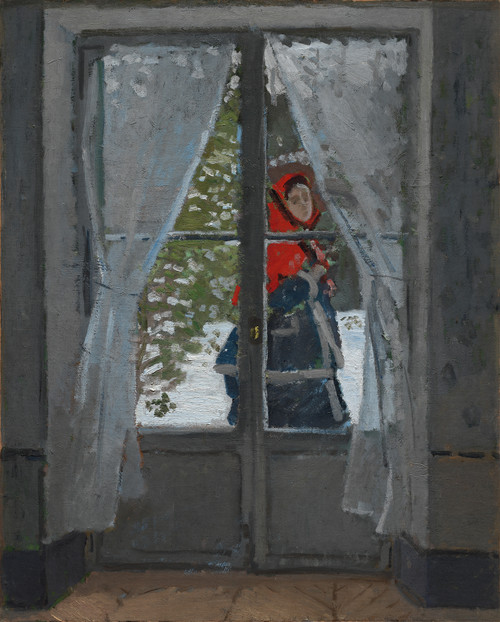
Portrait d'André Lauvray, painted in 1880 by Claude Monet, occupies a pivotal position within the artist's oeuvre, marking a transition from his early figurative works to the more radical innovations of Impressionism. The painting's textured brushwork, characterized by thick impasto strokes, imbues the subject with an almost palpable physicality, as if the paint itself has been raised from the canvas like the contours of André Lauvray's face.
The palette, predominantly composed of blues, yellows, and pinks, is juxtaposed against a grey background, creating a visual tension that recalls the atmospheric effects of Monet's contemporaneous landscapes. When enlarged to 44x54 inches, the painting's spatial rhythm becomes more pronounced, with the diagonal axis established by Lauvray's gaze drawing the viewer's eye through the composition like an unseen thread. The chromatic structure, initially fragmented and expressionistic, begins to reveal a deeper harmony as the viewer steps back, the blues and yellows modulating into one another like the play of light on water.
In a luxury interior environment, Portrait d'André Lauvray would function as a designed object, its spatial impact tempered by the surrounding architecture. Paired with materials such as dark wood or metallic accents, the painting's atmospheric weight would be heightened, the textured brushwork taking on an almost sculptural quality in relation to adjacent surfaces. Lighting, too, would play a crucial role, with carefully calibrated fixtures casting shadows that enhance the painting's expressive qualities while minimizing visual noise.
The design of the room would need to respect the painting's compositional structure, avoiding competing visual axes or overly ornate details that might disrupt its spatial rhythm. By pairing Portrait d'André Lauvray with a similarly modern and contemporary aesthetic, the luxury interior environment would be imbued with a sense of cohesion, as if the artwork has been integrated into the very fabric of the space itself.
In such an environment, the painting's palette would continue to exert its influence, the blues and yellows subtly informing the choice of adjacent materials and colors. The atmosphere created by Monet's use of impasto and glaze would be reflected in the room's overall ambiance, a carefully calibrated balance of light and shadow that envelops the viewer like a subtle mist.
By virtue of its size and scale, Portrait d'André Lauvray becomes an integral component of the luxury interior environment, its spatial impact tempered by the surrounding architecture while continuing to exert its influence through color, texture, and atmosphere.
This edition's spatial clarity and controlled palette align naturally with modernist interiors.
Architectural Behavior
Its vertical rise introduces a stabilizing architectural counterpoint.
This edition functions as a 44x54 interior anchor, shaping spatial rhythm and establishing a stable visual cadence within the surrounding architecture.
Its chromatic structure responds to natural and artificial lighting, modulating depth and atmospheric weight throughout the day.
Recommended material pairings include natural oak, brushed metal, matte stone composites, and textured linen surfaces.
Gallery Edition Specifications
- Format: 44" x 54" Interior Architectural Study
- Medium: 330gsm Ultra-Premium Fine Art Matte
- Ink System: Wide-gamut archival pigment curation
- Mounting: Delivered unframed for professional gallery installation
Each edition is prepared to order. Gallery-standard quality control requires 3 to 5 business days.