Curatorial Narrative
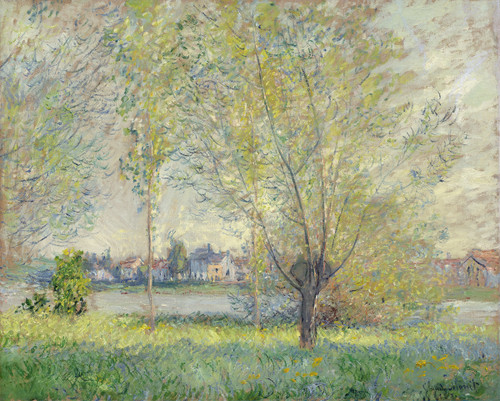
Rocks at Port-Goulphar, Belle-Île marks a pivotal moment in Monet's oeuvre, one that distills the painterly essence of his Impressionist practice. Executed in 1886, this work embodies the artist's fascination with light and its transformative power over the landscape. The brushwork is characterized by an almost tactile quality, achieved through the deliberate application of paint in thick, impasto strokes. This technique imbues the canvas with a textured, almost three-dimensional quality that invites the viewer to engage with the subject on a visceral level.
When enlarged to a scale suitable for a luxury interior environment – say, 54 x 44 inches – Monet's palette and spatial depth assume a new dimensionality. The blues and greens of the sea and rocks take on an almost material presence, while the surrounding foliage appears to recede into a realm of atmospheric weight. The chromatic structure of the painting, with its deliberate gradations from cool blues to warm purples, is refracted through the medium of interior space in unexpected ways. In conjunction with suitable materials – such as limestone or terrazzo flooring – and judicious lighting, Monet's spatial rhythm and compositional structure can be made to resonate within a room's architectural envelope, generating an atmosphere that is at once calming and energizing.
Rocks at Port-Goulphar, Belle-Île's modernist sensibility makes it an excellent fit for spaces characterized by minimalist restraint. However, its subtle color gradations also lend themselves to pairing with more luxurious materials – such as silk or velvet – in a way that creates visual tension and interest within the space. Moreover, the painting's atmospheric weight serves to mitigate the effects of high ceilings and expansive vistas, effectively creating a sense of spatial intimacy even in the most capacious of rooms.
The interplay between light and color is, of course, a hallmark of Monet's Impressionist practice, but here it assumes an almost architectural quality. As with any designed object – be it painting or building – the relationship between form, material, and environment is paramount. In this context, Rocks at Port-Goulphar, Belle-Île functions as a kind of visual keystone, one that harmonizes disparate elements within the room to create an overall sense of cohesion and balance.
Monet's decision to emphasize the rocks and sea in the foreground – rather than simply depicting the view – imbues the painting with a sense of spatial compression. This effect is heightened when the work is enlarged to a large scale, whereupon the surrounding foliage appears to recede into the background, creating a striking visual contrast between the near-field and far-field elements.
The overall impact of Rocks at Port-Goulphar, Belle-Île within a luxury interior environment is thus one of subtle yet insistent presence. Its Modernist structure and atmospheric weight serve to modulate the space's acoustic properties – effectively absorbing sound while refracting light in unexpected ways. In this sense, Monet's painting can be seen as a kind of designed object, one that harmonizes with its surroundings through a complex interplay of material, light, and spatial relationships.
The brushwork in Rocks at Port-Goulphar, Belle-Île – characterized by thick, impasto strokes – creates a tactile quality on the canvas's surface. This deliberate texture imbues the painting with an almost three-dimensional presence, one that rewards close observation and contemplation. In conjunction with suitable materials and lighting, Monet's work can be made to resonate within a room's architectural envelope in a way that is both calming and energizing.
The palette of Rocks at Port-Goulphar, Belle-Île – comprising blues
This edition's spatial clarity and controlled palette align naturally with modernist interiors.
Architectural Behavior
Its horizontal span reinforces axial movement across long architectural planes.
This edition functions as a 54x44 interior anchor, shaping spatial rhythm and establishing a stable visual cadence within the surrounding architecture.
Its chromatic structure responds to natural and artificial lighting, modulating depth and atmospheric weight throughout the day.
Recommended material pairings include natural oak, brushed metal, matte stone composites, and textured linen surfaces.
Gallery Edition Specifications
- Format: 54" x 44" Interior Architectural Study
- Medium: 330gsm Ultra-Premium Fine Art Matte
- Ink System: Wide-gamut archival pigment curation
- Mounting: Delivered unframed for professional gallery installation
Each edition is prepared to order. Gallery-standard quality control requires 3 to 5 business days.