Curatorial Narrative
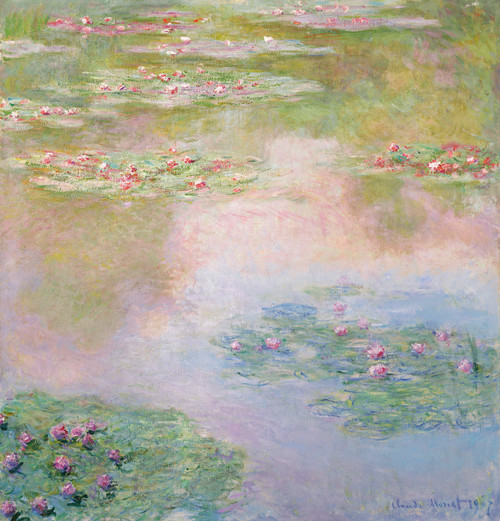
Étretat, The Beach and the Falaise d'Amont is a seminal work in Monet's oeuvre, executed in 1885 during the height of his Impressionist period. Characterized by a bold impasto technique, this painting embodies the artist's innovative approach to capturing light and atmosphere on canvas. By employing thick layers of paint, Monet achieves an almost three-dimensional quality, imbuing the landscape with a sense of solidity and weight that belies its ethereal subject matter.
As one considers the spatial implications of enlarging Étretat to 44x45 feet, the chromatic structure and atmospheric weight of the painting become increasingly apparent. The palette, which initially appears impressionistic and fleeting, reveals itself to be richly layered upon closer inspection. Blues and greens recede into the background, creating a sense of depth that is reinforced by the Falaise d'Amont's vertical axis. When paired with luxurious materials such as silk or linen, these hues take on a subtle, almost iridescent quality that seems to shift and change in response to shifting light conditions.
The brushwork, meanwhile, assumes a dynamic spatial rhythm, its thick impastos creating a textured, almost sculptural quality that invites the viewer's gaze to traverse the surface of the painting. In an interior environment, this would be particularly effective when paired with materials featuring subtle texture or pattern – for instance, a velvet sofa or a marble floor. The lighting behavior of the painting is similarly striking, its atmospheric weight creating a sense of drama and tension that can be heightened by judicious placement of light sources.
In terms of spatial impact, Étretat's enlarged scale would undoubtedly dominate an interior space, its imposing vertical axis drawing the viewer's gaze upward in a manner reminiscent of Gothic architecture. The painting's chromatic structure, meanwhile, creates a sense of visual harmony that can be reinforced by strategic placement of complementary colors or textures – for instance, a warm-toned wood floor or a grouping of blue-and-white ceramics.
The overall effect would be one of dynamic tension and visual drama, as the spatial rhythms and atmospheric weights of the painting engage with those of the surrounding interior environment in a rich and complex dialogue.
This edition's spatial clarity and controlled palette align naturally with modernist interiors.
Architectural Behavior
Its horizontal span reinforces axial movement across long architectural planes.
This edition functions as a 44x45 interior anchor, shaping spatial rhythm and establishing a stable visual cadence within the surrounding architecture.
Its chromatic structure responds to natural and artificial lighting, modulating depth and atmospheric weight throughout the day.
Recommended material pairings include natural oak, brushed metal, matte stone composites, and textured linen surfaces.
Gallery Edition Specifications
- Format: 44" x 45" Interior Architectural Study
- Medium: 330gsm Ultra-Premium Fine Art Matte
- Ink System: Wide-gamut archival pigment curation
- Mounting: Delivered unframed for professional gallery installation
Each edition is prepared to order. Gallery-standard quality control requires 3 to 5 business days.