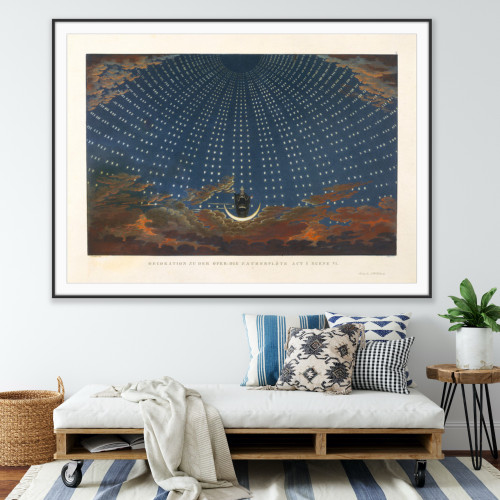
This celestial stage design—created after Karl Friedrich Schinkel and finished by Karl Friedrich Thiele—was produced for a nineteenth-century publication of Schinkel’s legendary sets for Mozart’s Die Zauberflöte. Printed as an aquatint and hand-colored with extraordinary care, the work depicts the Queen of the Night’s domain: a star-filled vault radiating outward from a central point, a crescent moon supporting a solitary figure, and dramatic clouds glowing with red and gold. At large scale, the composition becomes immersive, functioning as a luminous architectural surface rather than a decorative print.
The Scale and the Form
The original artwork is a horizontal composition with a 1.4:1 aspect ratio. To preserve this proportion while meeting professional interior design standards, the smallest dimension of each print is set at either 44" or 60", resulting in true architectural widths of 62" and 84". This scale is essential: it allows the starburst pattern to read as a full celestial dome and gives the crescent moon and figure the presence they were meant to have on stage. The matte surface keeps the gradients soft and eliminates glare, preserving the atmospheric glow across the sky.
Why This Matters for Your Space
This print introduces drama, depth, and a sense of cosmic order into a room. The radiating star pattern naturally anchors sightlines, making it ideal for spaces that need a strong visual center. The cool blues of the night sky balance the warm reds of the clouds, creating a palette that works in both minimalist and richly layered interiors. Because the composition is theatrical yet controlled, it integrates seamlessly into hospitality environments, creative studios, music rooms, and contemporary residential spaces.
How Designers Use It
Ideal for:
- Feature walls in hospitality or entertainment spaces
- Music rooms, theaters, or creative studios
- Interiors needing a dramatic focal point with celestial or mythic themes
Works best with interiors featuring:
- Dark woods, deep blues, brushed brass, or velvet textures
- Minimalist rooms needing a single dramatic anchor
- Soft ambient lighting or concealed LED coves to enhance the starburst effect
What You’re Actually Buying
- Available Sizes: 62" x 44" (Residential Scale) or 84" x 60" (Architectural Scale)
- Material: 330gsm fine art matte paper (archival grade)
- Ink: Wide-format pigment ink (high UV resistance)
- Finish: Unframed (rolled, shipped in reinforced archival tube)
- Color Profile: Cool blues, radiant whites, warm red and gold cloud tones
Shipping & Logistics
- Free U.S. shipping
- Rolled and secured in protective archival tissue inside reinforced shipping tubes
- Guaranteed arrival with zero compression, folds, or bending
About Karl Friedrich Schinkel’s Design for The Magic Flute: The Hall of Stars in the Palace of the Queen of the Night, Act 1, Scene 6
Karl Friedrich Schinkel’s stage designs for Mozart’s The Magic Flute are among the most celebrated theatrical artworks of the 19th century. The Hall of Stars presents a celestial, dreamlike environment built from radiating light, atmospheric color, and architectural fantasy. Schinkel’s vision merges Enlightenment symbolism, Masonic iconography, and Romantic theatricality, creating a world that feels both mythic and architecturally precise. His designs became foundational references for stagecraft, scenography, and the visual language of opera.
For authoritative museum context, artwork details, and high‑resolution imagery, visit The Metropolitan Museum of Art: The Met — Schinkel, The Magic Flute: The Hall of Stars