Curatorial Narrative
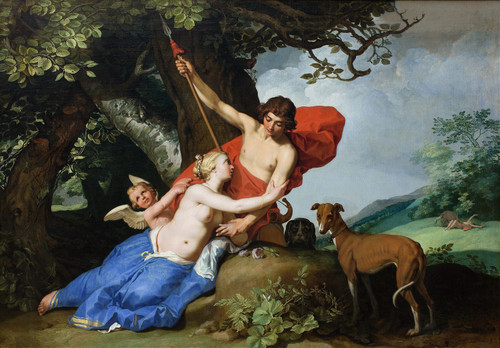
In the early 17th century, Abraham Bloemaert's "Venus and Bacchus (Without Ceres and Bacchus Venus would Frieze)" exemplifies the refined sensibilities of Renaissance Revival, its intricate brushwork and delicate palette underscoring a masterful understanding of composition.
This print's atmospheric weight is a product of its chromatic structure, wherein neutral tones predominate while subtle brown and beige hues provide nuanced contrast. As the subject matter unfolds within the spatial rhythm established by Bloemaert, an interplay between figurative and void occurs, lending an air of contemplation to the scene.
The print's visual mechanics reveal a Renaissance style that is both fine and restrained in its execution. This control is evident in the precise manner with which the artist balances the figures and their surroundings, avoiding sentimentality while cultivating a sense of stillness. The subject itself – a figure from Roman mythology – would have been familiar to Bloemaert's audience as a testament to the enduring allure of classical motifs.
The scale of this print demands attention when enlarged to 56x44. At such dimensions, the spatial depth established by the artist becomes even more pronounced, drawing the viewer into the scene while emphasizing its figurative content. In a luxury interior environment, this enlargement would be particularly effective in settings where material pairing is deliberate and restrained – for example, in rooms featuring fine woods or rich textiles. The atmospheric weight imparted by Bloemaert's palette also plays a crucial role here: as lighting illuminates the subtle brown and beige hues, it imbues the space with a sense of warmth while subtly emphasizing the chromatic structure that underpins the composition.
As "Venus and Bacchus (Without Ceres and Bacchus Venus would Frieze)" asserts its presence within an interior environment, it assumes a role analogous to a carefully crafted piece of furniture. Like any well-designed object, this print establishes a spatial rhythm that harmonizes with other elements in the room – be they architectural features or decorative accessories. And just as a beautifully proportioned chair will direct attention towards specific areas of the space while providing a sense of balance and cohesion, Bloemaert's print does the same, exerting a quiet yet unmistakable influence over its surroundings through its chromatic structure and spatial depth.
The interplay between material and light is also noteworthy when considering this print in a luxury interior context. As the subtle brown and beige hues interact with the surrounding environment, they imbue the space with a sense of subtlety while avoiding dramatic visual contrasts. This restraint is essential for maintaining an atmosphere of refinement within such settings – one that prioritizes elegance over overt spectacle.
This print's influence on spatial impact cannot be overstated: as it unfolds across 56x44, its subtle nuances and delicate brushwork imbue the surrounding space with a sense of quiet contemplation. Even in environments where competing visual stimuli are present, "Venus and Bacchus (Without Ceres and Bacchus Venus would Frieze)" establishes itself as a carefully considered element – one that harmonizes with other design elements while subtly shaping their interaction.
Ultimately, this print's relevance to luxury interior design stems from its ability to establish an atmosphere of refinement through careful composition. By balancing figurative content within a precisely calibrated spatial rhythm, Bloemaert creates a visual experience that is both meditative and engaging – one that rewards close attention without ever succumbing to sentimentality or overstatement.
This edition adapts fluidly across contemporary interior profiles, offering a stable architectural anchor.
Architectural Behavior
Its horizontal span reinforces axial movement across long architectural planes.
This edition functions as a 56x44 interior anchor, shaping spatial rhythm and establishing a stable visual cadence within the surrounding architecture.
Its chromatic structure responds to natural and artificial lighting, modulating depth and atmospheric weight throughout the day.
Recommended material pairings include natural oak, brushed metal, matte stone composites, and textured linen surfaces.
Gallery Edition Specifications
- Format: 56" x 44" Interior Architectural Study
- Medium: 330gsm Ultra-Premium Fine Art Matte
- Ink System: Wide-gamut archival pigment curation
- Mounting: Delivered unframed for professional gallery installation
Each edition is prepared to order. Gallery-standard quality control requires 3 to 5 business days.