Curatorial Narrative
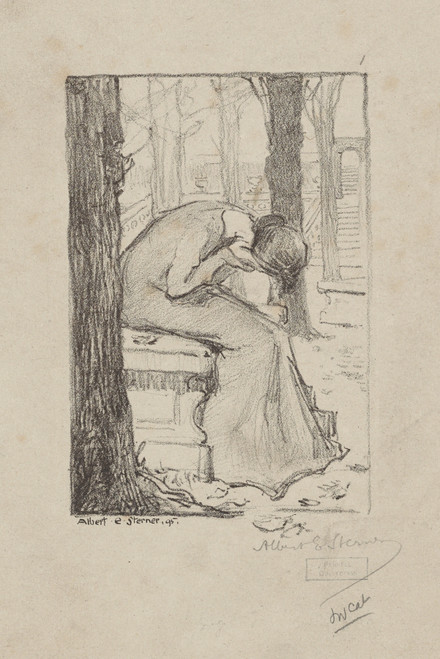
In the context of early 20th-century American art, Albert Sterner's "Lady Tranmore and Mary Lyster" occupies a unique position within the Victorian revival movement. Executed in 1904, this work embodies the artist's fascination with the formal elegance of Regency-era portraiture, as filtered through his own distinctively modernist sensibility. The linear brushwork, characteristic of Sterner's style, imbues the figures with a subtle, almost effaced quality, as if they might dissolve into their surroundings at any moment.
The sepia-toned palette and muted earthy hues employed by Sterner lend an atmosphere of subdued refinement to this interior scene. When enlarged to 44x65 inches, the artwork's spatial rhythm begins to assert itself more forcefully, drawing the viewer's eye through a series of carefully calibrated visual intervals. The chromatic structure, with its subtle gradations of tone and texture, assumes a weighty, almost monumental quality that would be perfectly at home in a luxury interior environment. In this context, material pairing becomes all-important: consider pairing the deep, rich tones of a hand-carved wooden panel with the cool, creamy sheen of a French limestone floor to create a harmonious visual dialogue with Sterner's painting. As for lighting behavior, the soft, diffused glow cast by a carefully placed chandelier or sconce would only serve to enhance the atmospheric weight and depth of the artwork, drawing the viewer inexorably into its contemplative, almost somnambulant world.
In this larger format, the compositional structure of "Lady Tranmore and Mary Lyster" reveals itself to be far more intricate than initially meets the eye. Sterner's use of spatial depth, achieved through a combination of atmospheric perspective and subtle modulation of tone, creates a sense of layered, almost three-dimensional space that rewards close examination. When paired with carefully considered architectural elements – such as a beautifully proportioned doorway or a sweeping staircase – this painting can assume an almost sculptural presence within the luxury interior environment, its chromatic structure interacting in a complex dance with the surrounding material and spatial conditions.
The enlarged format also reveals Sterner's masterful handling of light and shadow to be a key component of his visual language. As the figures in the painting are bathed in a soft, diffused glow, their forms assume a heightened sense of presence and volume, as if they might step out from the canvas at any moment. This effect would be perfectly complemented by the judicious placement of light sources within the surrounding interior environment – for example, by casting a warm, golden glow across a nearby console table or sideboard.
As we consider the place of "Lady Tranmore and Mary Lyster" within the luxury interior environment, it becomes clear that this painting is not simply a decorative element, but a carefully crafted object with its own unique spatial and material properties. Its interaction with the surrounding architecture and furnishings would be a key component of any successful interior design strategy, as Sterner's masterful handling of light, color, and composition would serve to heighten the overall sense of atmosphere and visual tension within the space.
In conclusion, Albert Sterner's "Lady Tranmore and Mary Lyster" is a painting that rewards close examination and consideration within the luxury interior environment. Its unique blend of Victorian elegance and modernist sensibility makes it an ideal choice for those seeking to create a sophisticated, contemplative atmosphere within their homes or public spaces.
This edition adapts fluidly across contemporary interior profiles, offering a stable architectural anchor.
Architectural Behavior
Its vertical rise introduces a stabilizing architectural counterpoint.
This edition functions as a 44x65 interior anchor, shaping spatial rhythm and establishing a stable visual cadence within the surrounding architecture.
Its chromatic structure responds to natural and artificial lighting, modulating depth and atmospheric weight throughout the day.
Recommended material pairings include natural oak, brushed metal, matte stone composites, and textured linen surfaces.
Gallery Edition Specifications
- Format: 44" x 65" Interior Architectural Study
- Medium: 330gsm Ultra-Premium Fine Art Matte
- Ink System: Wide-gamut archival pigment curation
- Mounting: Delivered unframed for professional gallery installation
Each edition is prepared to order. Gallery-standard quality control requires 3 to 5 business days.